Showing posts with label Daniele. Show all posts

Tuesday, April 13, 2010

Contaminated Pepper Recalls: Nothing To Sneeze At

Original Post, March 12, 2010; Last Update, April 13, 2010

FDA confirmed, in a statement issued on March 11th, that Salmonella has been found in multiple samples of imported black and red pepper supplied to Daniele International, Inc. At least one of the Salmonella cultures was a genetic match for the strain of Salmonella Montevideo that has sickened at least 249 people in the United States since July 1, 2009.

Daniele International recalled more than 1.26 million pounds of ready-to-eat Italian deli meats and sausages during January and February after the company's salami was identified as the probable source of a significant fraction of the Salmonella Montevideo illnesses.

FDA's recovery of Salmonella from pepper samples has resulted in the following recalls in the USA, Canada and Mexico.


Bass Pro Shops®
Uncle Buck's® Beer Batter Mix Lightly-Seasoned (code date w9308k), distributed in Bass Pro Shops® stores nationwide, on basspro.com and at select retailers.


Binelli Bros. Cutlery
Ground black pepper, distributed by Binelli Bros. Cutlery in the state of Michigan only.


Dutch Valley Food Distributors, Inc.
Dutch Valley has recalled peppercorns, ground pepper, seasoning mixes and dip mixes, distributed nationwide under the Bulk Foods, Inc. label, through retailers and on the company's website.


Frontier Natural Products Co-op
Frontier Natural has recalled Frontier and Whole Foods Market brands of spices, distributed in bulk sections and in retail packaging nationwide in the US and some parts of Canada. Some Frontier brand spices were sold in Kroger, Smith's, QFC, Fred Meyer, Giant, Tops, and Wegmans stores.

Canadian Food Inspection Agency reports on March 12th, March 16th and March 17th that the following items were distributed in Canada:
  • Frontier Curry Powder, 453g
  • Frontier Black Pepper Coarse Grind, 454g
  • Frontier Peppercorns Black Whole L/M, 454g
  • Frontier Garlic N Herb Blend, 16 oz/453g
  • Frontier Greek Seasoning Blend, 16 oz/453g
  • Frontier Muchi Curry Powder, 16 oz/453g
  • Frontier Spaghetti Seasoning, 16 oz/453g
  • Frontier Thai Seasoning Blend, 16 oz./453g
  • Frontier Veggie Pepper Blend, 16 oz/453g
  • Whole Foods Market 365 Asian Seafood Seasoning, 4.62oz./131 g
  • Whole Foods Market 365 Mediterranean Seafood Seasoning, 4.23oz./120 g
  • Whole Foods Market 365 Mediterranean Rotisserie Seasoning, 4.73oz. 134 g
  • Whole Foods Market 365 Toronto Steak & Chicken Rub, 4.76oz. 135 g

Gorton's, Inc.

C. H. Guenther & Son, Inc.
Specific products within the Sunbird Seasonings, Williams Wings Seasonings and Williams Gumbo Soup lines, sold in grocery, warehouse and other retail outlets throughout the United States.

C.H. Guenther & Son, Inc. announced the recall of Chilli Man Branded Seasoning Mix pouches (Code date W0004Q) on March 18th. The recalled product was sold in grocery and other retail outlets throughout the United States.

The following products, sold in grocery stores throughout the United States, were added to the Guenther recall notice on March 22nd.
  • Bayou Heat Spicy Wings Seasoning
  • Shop’n Save Chicken Roasting Bag & Seasoning Blend
  • Carlita Fajita Seasoning Mix
  • La Tiara Taco Seasoning
  • Shurfine Pork Gravy
  • Shurfine Season ‘n Bake for Chicken-with bag
  • Western Family Pork Gravy Mix
  • Western Family Season ‘n Bake for Chicken with bag
  • HY-TOP Pork Gravy Mix
  • HY-TOP Fajita Seasoning Mix
  • HY-TOP Cooking Bag & Seasoning Blend for Chicken
  • HY-TOP Marinade Southwest-Flavor for Meat or Chicken
  • IGA Bag’n Bake – Cooking Bag and Seasoning Mix Chicken
  • Parade Fajita Seasoning Mix
  • Parade Pork Gravy Mix
  • Weis Chicken Season ‘n Bake – Roasting Bag and Seasoning
  • H-E-B Beef Stew Seasoning Mix
  • H-E-B Meat Loaf Seasoning Mix,
  • H-E-B Sloppy Joe Mix
The following C.H. Guenther products, sold in grocery stores across the USA, were added to the recall list on March 23, 2010:
  • Best Yet Season 'n Bake Chicken
  • Food Club Beef Stew
  • Tops Pork Gravy
  • Piggly Wiggly Season 'n Bake Chicken

H.D.W. Foods Inc.

Heartland Foods, Inc.
Heartland has recalled all sizes/containers of COARSE GROUND BLACK PEPPER shipped from their Indianapolis facility between October 19th, 2009 and February 17th, 2010, inclusive.


John B. Sanfilippo & Son, Inc.
Sanfilippo has recalled Fisher Louisiana Cajun Mix (distributed in Fisher Outlet stores in Northern Illinois) and several Archer Farms Brand nut and trail mixes (distributed exclusively in Target stores nationwide). The recalled products contain black pepper supplied by Mincing Overseas Spice Company and may be contaminated with Salmonella.


Little Caesar Spice Paks
Blue Line Foodservice Distribution recalls Little Caesar Spice Paks that were handed out at consumer request in Little Caesar stores in the United States, Canada and Mexico. The small white packets measure 1.25" x 2.5" and do not show any identifying UPC or lot code.


McCain Foods USA
McCain recalls McCain All American Roasters (24 oz bag; lot code #W91125; produced November 25, 2009), because the potato product contains black pepper that may be contaminated with Salmonella. The recalled item was sold in grocery stores across the USA.


Mincing Overseas Spice Company
Mincing Overseas recalled black pepper (Lots 3258 and 3309), packaged in 50 lb, 25 lb, and 20 lb cartons with Mincing Overseas Spice Company's name. The recalled black pepper was shipped to customers (including Daniele International, Dutch Valley, and Frontier Natural) in FL, IA, IL, IN, MA, OK, NJ, NY, PA, RI, TX and WI.


Spice Barn
Spice Barn, Inc. recalls two lots of black pepper, distributed to customers in VT, NY, PA, MA, GA, VA, CA, TX, CO, MO, WA, FL, AL, MI, AZ, AR, WA.
  • Malabar Peppercorns, Lot MTC-3258 (1 & 5 lb Bags); Distributed from 1/26/10 to 2/8/10
  • Ground Black Pepper, Lot MO-3258T (1 & 5 lb Bags); Distributed from 12/08/09 to 2/8/10.

Top Food & Drug
Muchi Curry Powder, Hot (UPC 089836-001382; Lots 0004 and 9350)


Tops Friendly Markets
Tops Pork Gravy Mix (1 oz.), Lots #W9327B & W9328B


Tree of Life Canada
Tree of Life Canada ULC (Mississauga, ON) recalls the following products, that contain black pepper recalled by Mincing Overseas Spice Company. The recalled items were distributed across Canada.
  • Sun Bird Thai Fried Rice (28g), lot codes W0011G and W9309G
  • Sun Bird Chop Suey (28g), lot code W0006G
  • Sun Bird Chow Mein (28g), lot codes W0005G and W9316G
  • Sun Bird Fried Rice (21g), lot codes W9320G and W9334G


Wholesome Spice
Wholesome Spice recalled all lots of 25 lb boxes of Crushed Red Pepper sold between 4/6/09 and 1/20/10. The recalled red pepper was distributed to customers in the US Northeast, including Daniele International.


This recall list will be updated as additional recalls are announced.

If you would like to receive automatic email alerts for all new articles posted on eFoodAlert, please click here or submit your request using the sidebar link. Please include "subscribe eFoodAlert" in the subject line.

Thursday, March 11, 2010

Contaminated Pepper Toll: 257 Ill and Counting

Pepper-derived recalls ripple through USA and Canada

The number of Salmonella illnesses due to contaminated pepper in the United States has risen to at least 257 people in 44 states and the District of Columbia, according to the latest update released today by the Centers for Disease Control and Prevention.

Eight of the victims were infected with Salmonella Senftenberg; the other 249 with Salmonella Montevideo. At the moment, CDC only recognizes the 249 Salmonella Montevideo victims in its outbreak totals.

The outbreak began in July 2009, and new cases are still being reported; the most recent reported onset date is February 18, 2010.

CDC first released information about this outbreak on the agency website on January 22, 2010. As of that date, 184 people were thought to have been infected with Salmonella Montevideo. The culprit, as yet unidentified, was suspected to be a widely distributed contaminated food. The very next day, investigators announced that Italian-style salami sausage manufactured by Daniele International, Inc. was the most likely source of at least some of the outbreak illnesses.

Although Daniele recalled the suspect meats, no one – not CDC, not FDA, not the Rhode Island Department of Health, not Daniele – found the explanation fully satisfying. Too many victims did not remember having eaten salami during the several days before they became ill. There was something else at work.

On January 23rd, I suggested – in the face of significant skepticism on the part of some readers – that contaminated pepper might be the source of the outbreak. I was drawn to this conclusion by the list of pepper-encrusted meats that formed Daniele's first product recall. Subsequent events have borne me out.

On January 28th, the Rhode Island Department of Health announced having found the Salmonella Montevideo outbreak strain in a sample taken from an open container of black pepper located at Daniele's production facility. Since that initial finding, FDA has found Salmonella in pepper samples obtained from Daniele's two spice suppliers – Wholesome Spice Company and Mincing Overseas Spice Company. At least one of the Salmonella isolates matched the outbreak strain. Genetic profiling of isolates from additional samples is in progress.

As a result of FDA's findings, both Wholesome and Mincing Overseas initiated recalls. And the ripple effect of those recalls has spread – and will continue to spread – across the processed food industry as FDA continues its trace-forward investigations. Companies that have initiated recalls so far include:


While most of the recalled spices were distributed in the United States, Frontier Natural reports that some of its recalled products also were distributed in Canada.

To help readers navigate the pepper recalls, I shall be posting a consolidated recall list within the next 24 hours. Please check back.

If you would like to receive automatic email alerts for all new articles posted on eFoodAlert, please click here or submit your request using the sidebar link. Please include "subscribe eFoodAlert" in the subject line.

Wednesday, March 10, 2010

Recall Roundup: March 10, 2010

Here is today's list of food safety recalls, product withdrawals and allergy alerts. The live links will take you directly to the official recall notices and company news releases that contain detailed information for each recall and alert.

If you would like to receive automatic email alerts for all new articles posted on eFoodAlert, please click here or submit your request using the sidebar link. Please include "subscribe eFoodAlert" in the subject line.


United States
  • Allergy Alert: Neco Foods LLC, in concert with Publix Super Markets, recalls Publix Private Label Brand Potato, Cheddar & Bacon Soup, because the product contains milk that is not declared on the label.
  • Food Safety Recall: Dutch Valley Food Distributors, Inc. recalls Bulk Foods Inc. brand black pepper products, seasoning mixes and dip mixes because the black pepper supplied by Mincing Overseas Spice Company may be contaminated with Salmonella.
  • Food Safety Recall: Ruiz Foods, Inc. (Denison, TX) recalls approximately 115,700 pounds of a ready-to-eat (RTE) beef product that may be contaminated with Salmonella.
  • Food Safety Recall: Windsor Foods (Lampasas, TX and Oakland, MS) recalls approximately 1.7 million pounds of ready-to-eat (RTE) beef taquito and chicken quesadilla products that may be contaminated with Salmonella.
  • Food Safety Recall: N.K. Hurst Company recalls Hurst's Beef 15 Bean Soup, because it may be contaminated with Salmonella.
  • Food Safety Recall: Giant Eagle recalls Giant Eagle brand Onion Gravy Mix that may be contaminated with Salmonella.
  • Food Safety Recall: Nutritional Resources, Inc. recalls Healthwise Cream of Mushroom Soup that may be contaminated with Salmonella.
  • Food Safety Recall: Ritacco's Market (Westerly, RI) recalls all ready-to-eat dry cured sausage products manufactured at the facility because they may be contaminated with Salmonella. The recall was initiated after a soprosata (sopressata) sample collected by the Rhode Island Department of Health tested positive for Salmonella typhimurium.
  • Food Safety Recall: ACH Food Companies, Inc. recalls certain French's, Durkee and Weber brands of Italian seasoning and spaghetti sauce mixes that may be contaminated with Salmonella.
  • FDA Warning Letter: FDA warns Scotty's Inc. that an August 2009 inspection of the company's food processing facility revealed insanitary conditions and violations of Title 21 of the Code of Federal Regulations (21 CFR) Part 110: Current Good Manufacturing Practice in Manufacturing, Packing, or Holding Human Food.
  • FDA Warning Letter: FDA warns Lucky Farm Inc. that a September/October 2009 inspection of the company's bean sprouting facility revealed significant insanitary conditions, including evidence of rodent infestation.


Canada
  • Food Safety Recall: Canadian Food Inspection Agency alerts consumers to recall of Sabatini's spinach and vegetable dips and Mom's Pantry All Dressed Popcorn Seasoning that may be contaminated with Salmonella.
  • Food Safety Recall: Moonstruck Organic Cheese recalls White Moon, Savoury Moon, and Ash-Ripened varieties of Camembert cheese that may be contaminated with Listeria monocytogenes, after routine sampling by the British Columbia government found the pathogen in a sample. The recalled cheese was sold through retailers in British Columbia.
  • "Natural" Health Product Alert: Health Canada alerts consumers that the unapproved health product Power-Max contains the erectile dysfunction drug sildenafil, and may cause serious side effects.

Europe
  • Allergy Alert (UK): Sainsbury's withdraws mislabeled pots of Mandarin Jelly, which contain undeclared milk, egg and wheat gluten.
  • Allergy Alert (Ireland): Foxhill Foods Ltd. (UK) recalls three batches of Basil Pesto, which may contain undeclared cheese.
  • Food Safety Recall (Denmark): Nordic Food Partners A/S recalls three varieties of Organic Brown Rice due to mold contamination.


Australia and New Zealand
  • Dietary Supplement Safety Alert (Australia): The Therapeutic Goods Administration alerts consumers that Botanical Slimming 100% Natural Soft Gel (a.k.a. Meizitang), which is sold over the internet, contains the prescription-only drug sibutramine, which may cause serious side-effects.


Some supermarket chains post recall notices on their web sites for the convenience of customers. To see whether a recalled food was carried by your favorite supermarket, follow the live link to the supermarket's recall web site.


*The Kroger umbrella encompasses numerous supermarket, marketplace and convenience store chains, listed on the Kroger corporate home page.


Thursday, February 25, 2010

FLASH: Daniele Supplier Recalls Crushed Red Pepper

FDA today posted the following recall notice:

Wholesome Spice of Brooklyn, NY is recalling all lots of 25 lb boxes of Crushed Red Pepper sold between 4/6/09 and 1/20/10, because they have the potential to be contaminated with Salmonella, an organism which can cause serious and sometimes fatal infections in young children, frail or elderly people, and others with weakened immune systems. Healthy persons infected with Salmonella often experience fever, diarrhea (which may be bloody), nausea, vomiting and abdominal pain. In rare circumstances, infection with Salmonella can result in the organism getting into the bloodstream and producing more severe illnesses such as arterial infections (i.e., infected aneurysms), endocarditis and arthritis.

The 25 lb boxes of Crushed Red pepper were distributed in the Northeastern U.S.. The product was not sold on the retail level to consumers.

The Crushed Red Pepper product is packaged in a clear plastic bag which is placed inside of a cardboard box with an adhesive white label with a blue border and blue and black lettering. The brand name on the product labels is WHOLESOME SPICES. The product name is listed as CRUSHED RED PEPPER.

It cannot be determined at this time if this product has been related to any illnesses to date.

The firm was informed that samples of its product have tested positive for Salmonella. The firm is currently working with the FDA to determine how the contamination occurred.

Manufacturers who have purchased 25 lb boxes of WHOLESOME SPICES brand Crushed Red Pepper are urged not to use the product and to recall any product they further distributed. Manufacturers with questions may contact the firm via telephone at (718) 388-1549. Our hours of operation are from Monday to Friday 8:30-4:30pm Eastern Standard Time.

Wholesome Spice was the first of two pepper suppliers implicated in the Daniele Salmonella outbreak. Contaminated salami products have been blamed for at least 238 cases of Salmonella Montevideo in 44 states since July 1, 2009; six cases of Salmonella Senftenberg in at least two states (California and Illinois) also may be part of this same outbreak.

f you would like to receive automatic email alerts for all new articles posted on eFoodAlert, please click here or submit your request using the sidebar link. Please include "subscribe eFoodAlert" in the subject line.
Friday, February 12, 2010

CDC Adds Second Salmonella To Daniele Outbreak Profile

Latest report notes – but excludes from outbreak totals – 5 cases of Salmonella Senftenberg

CDC announced late yesterday that 225 Salmonella Montevideo illnesses have now been linked to recalled Daniele salami. Cases have been reported by 44 states and the District of Columbia. At least 43 people have been hospitalized. None of the illnesses have been linked to salami from any other company.

An additional five people have been infected with a strain of Salmonella Senftenberg that matches the genetic profile of the Salmonella Senftenberg found in a package of Daniele salami in Washington State. One of the five people reported having eaten a recalled Daniele product during the week before become ill.

Two of the Salmonella Senftenberg cases are from California; one or more of the others may be from Illinois, which still had several illnesses under investigation as of February 6th.

Black pepper imported from Vietnam has been implicated as the source of Daniele's woes. FDA is still trying to recover Salmonella from previously unopened containers of the suspect pepper. So far, the only Salmonella-positive pepper samples were drawn from previously opened containers located at Daniele's Rhode Island food processing facility.

CDC reminds consumers to discard any recalled products or return them to the store for refund. Individuals who think that they have been made ill as a result of having eaten a recalled product should contact their health care providers.

If you would like to receive automatic email alerts for all new articles posted on eFoodAlert, please click here or submit your request using the sidebar link. Please include "subscribe eFoodAlert" in the subject line.

Wednesday, February 10, 2010

Pepper Production - A Dirty Business

Salmonella in pepper? Why am I not surprised?

Pepper is a fruit – a berry to be precise – with some similarities to grapes.

Both grow on vines. Both grow in clusters. Both are harvested by hand. But the resemblance ends at harvest.

While grapes are typically eaten fresh or pressed to make juice and wine, pepper – according to McCormick & Company – is the number one selling spice in the United States.

The pepper plant (proper name Piper nigrum) is a tropical plant and grows in countries with a seasonal monsoon climate, including India, Indonesia, Vietnam and Brazil. The vines can attain a height of 12 feet when properly supported by trees, poles, or trellises.

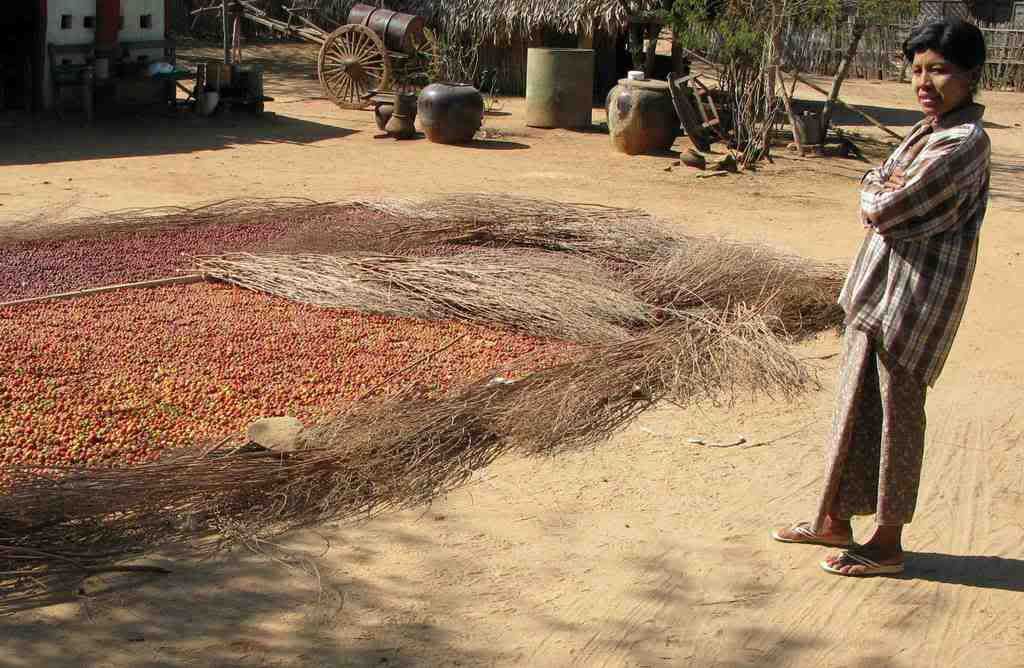
Once harvested, the pepper clusters are laid out on grass mats to dry in the sun. The berries are turned frequently, to ensure uniform drying and are brought indoors at night. After 7-10 days, they are ready to be sold.

At this stage, the dried pepper berries – now properly called peppercorns – are still loaded with a variety of stems, stones, dirt and debris. The processor must clean and grade the peppercorns before packaging them. Some processors, such as VKL Vietnam Ltd., steam-sterilize peppercorns and other spices to minimize the risk of microbiological contamination.

"How," you ask, "do microbes get onto the peppercorns?"

The answer is simple. It happens during the 7-10 days that the berries sit out in the sun to dry.

I travelled through Southeast Asia in 2008 and had the opportunity to see how both fruit and fish are dried in the sun in Laos and Myanmar (Burma). Although the Vietnam government has been trying to develop solar energy methods for drying produce, many small farmers in that country still use traditional methods.


Farmers in Myanmar dry their produce on grass mats laid on the ground in front of their houses, and "protect" the drying fruit with a border of straw.


In the same open area, one often finds:

The family cow or ox


And a free ranging chicken finding its lunch next to the family manure pile


Get the picture?

If you would like to receive automatic email alerts for all new articles posted on eFoodAlert, please click here or submit your request using the sidebar link. Please include "subscribe eFoodAlert" in the subject line.

The Other Salmonella In Daniele's Meat

Salmonella Senftenberg cases under investigation
(Posted February 6, 2010 and updated February 10, 2010)

The California Department of Public Health (CDPH) is investigating two isolated cases of Salmonella Senftenberg that match a strain recovered in late January from a Daniele variety package. So far, there is no epidemiological evidence linking the cases either to black pepper or to consumption of any Daniele meat product. According to Ron Owens of the CDPH Office of Public Affairs, the investigation is ongoing.

One or more other states may also be investigating Salmonella Senftenberg illness reports, but no one else is saying so publicly at this time.

Illinois has acknowledged that it is investigating "...a number of Salmonella cases that may be linked to the outbreak," but declined to be more specific. When I asked whether any of the cases involved Salmonella Senftenberg, I was told, "Hopefully soon CDC will make a determination of which serotypes of Salmonella will be included in the outbreak definition. At this point only Montevideo has been included."

Among the other states that were kind enough to respond to my inquiry, Florida simply referred me to the CDC and USDA web sites, and Minnesota replied that their policy is to not disclose any details of an active investigation. The following states have affirmed that they have no reported cases of Salmonella Senftenberg: Alabama, Arizona, Arkansas, Colorado, Connecticut, Hawaii, Idaho, Iowa, Kansas, Louisiana, Maine, Missouri, New Mexico, North Carolina, North Dakota, Oklahoma, Oregon, South Dakota, Tennessee, Utah, Vermont and Wisconsin (Updated February 10, 2010).

CDC, which is limiting the outbreak definition to cases of Salmonella Montevideo – at least for now – issued a status update on the outbreak yesterday afternoon. As of 9pm on February 4th, 213 individuals from 42 states and the District of Columbia are confirmed to have been infected with the Montevideo outbreak strain. At least 42 people have been hospitalized, and the known duration of the outbreak now stretches from July 4, 2009 to January 21, 2010.

Before CDC decides to change the outbreak definition to include Salmonella Senftenberg (or any other Salmonella strain), it will need convincing lab and epidemiological evidence. Full cooperation from possible outbreak victims would make this evidence much easier to collect.

While Salmonella cultures obtained from clinical samples must be reported to CDC, infected individuals are under no obligation to cooperate with epidemiological investigations to determine the source of the pathogen. A number of apparent victims of this outbreak have declined to answer the detailed food history questionnaire developed to determine whether their illnesses are linked to consumption of deli meats or pepper.

I urge anyone who has experienced symptoms of salmonellosis (diarrhea, stomach cramps, mild fever, nausea, etc.) to consult a doctor and, if asked, to cooperate fully with all follow-up investigations.

If you would like to receive automatic email alerts for all new articles posted on eFoodAlert, please click here or submit your request using the sidebar link.

Thursday, February 4, 2010

On The Trail of Daniele's Salame Recall

Retail Distribution List For Recalled Meats Linked to Salmonella Outbreak
Updated February 4, 2010

A number of retailers have issued recall notices for one or more of Daniele's cured meats. USDA released on February 4, 2010 an updated retail distribution list for Daniele's recalled meats. As the agency warns that their list might not be complete, please check both the USDA distribution list and the following list periodically for updates on where these products were sold.


USA

  • Stores in Arizona, Colorado, Idaho, Louisiana, Montana, New Mexico, Oregon, Texas, Utah, Washington, Wyoming

BevMo (wine, spirits and food chain in California and Arizona)
  • Stores in California

  • Stores in South Carolina, Tennessee

  • Daniele Italian Brand Gourmet containing Hot Calabrese, Pepper Salami and Hot Capocollo (style# 212095)

  • Dietz & Watson Artisan Collection Baby Genoa Pepper Salame
  • Dietz and Watson Artisan Collection Party Platter Pack

  • Stores in New Jersey

  • Stores in Texas

  • Daniele Peppered Salami, 8 oz. (UPC 7-36436-00049-8)

  • Entire Daniele recall notice posted on Costco website.

  • Stores in New York

  • Stores in Rhode Island

  • Stores in North Carolina, Tennessee

  • Stores in New Jersey

  • Stores in Texas

  • Boar's Head Salame Coated With Pepper
  • Daniele Gourmet Hot Variety Deli Meat
  • Daniele Deli Selection Tray
  • Boar's Head Hot Sopressata Calabrese

  • Stores in Oregon and Washington

  • Stores in District of Columbia, Delaware, Maryland, North Carolina, South Carolina, Tennessee, Virginia

  • Stores in Illinois

  • Stores in New Jersey, Pennsylvania

  • Boar's Head All-Natural Salame Coated With Black Pepper sold in Kroger, QFC, Ralphs, Smith's Food & Drug, Fry's Food and Fred Meyer stores
  • Daniele Salame SPC Gourmet Variety Pack sold in Fry's, Fred Meyer and Smith stores
  • Boar's Head Hot Flat Calabrese Sopressata sold in QFC, King Sooper's, Fred Meyer, and some Kroger stores

  • Stores in Massachusetts, New Hampshire, New Jersey

  • Stores in New Jersey, New York, Pennsylvania

  • Entire Daniele recall list posted on Price Chopper website.

  • Stores in South Carolina

  • Stores in Massachusetts

  • Stores in Indiana

  • Stores in Maryland, Virginia

  • Daniele Spicy Gourmet Variety Pack
  • Black Bear Baby Genoa Peppered Salame

  • Stores in Illinois, Indiana, Michigan, New York, Ohio, Pennsylvania, South Carolina

  • Stores in North Carolina
  • Store in Mobile, AL

  • Store in Knoxville, TN

  • Italian Brand Gourmet Variety Pack, UPC: 7-36436-84729

  • Stores in New York state

  • Entire Daniele recall notice posted on Walmart website.

  • Stores in Maryland, New Jersey, New York and Pennsylvania

  • Stores in Texas


PUERTO RICO
Although Puerto Rico does not appear on the USDA retail distribution list, a recently archived Daniele web page indicates that the Company's products are sold in the following stores:
  • Amigo
  • Costco
  • Grande
  • Sam's Club
  • Pueblo


CANADA
Costco (Manitoba, Saskatchewan, Alberta, British Columbia)
  • Italian Brand Gourmet Pack
  • Gourmet Italian Deli Selection Tray

Super C (Québec)
  • Gourmet Italian Deli Selection

MEXICO
A recently archived Daniele web page indicates that the Company's products were sold in the following stores:
  • City Club
  • Costco
  • Sam's Club
  • Superama
  • Walmart


ASIA
  • Daniele Natural Salame coated with coarse black pepper 3oz
  • Daniele Genoa Salame Pepper 1kg

Korea
A recently archived Daniele web page indicates that the Company's products were sold in the following stores:
  • Costco
  • E-marts

  • Daniele All Natural Salami Assortment (283g x 3 packs)


If you would like to receive automatic email alerts for all new articles posted on eFoodAlert, please click here or submit your request using the sidebar link.

Daniele Adds Two More Ready-To-Eat Meats To Recall List

Action comes after second supplier of contaminated pepper identified

Daniele International, Inc. expanded its recall list late this afternoon to include the following two items:
  • Daniele Naturale Salame coated with coarse black pepper (3 oz. packages)
  • Daniele Salame Grande coated with pork fat & pepper (approx. 6-lb packages)
The additions to the recall list bring the total amount of recalled ready-to-eat meat to 1,263,754 pounds.

The outbreak of Salmonella Montevideo gastroenteritis that has been linked to Daniele meat has grown to 207 confirmed cases in 42 states and the District of Columbia. Although some of the recalled meat was exported to Canada, Taiwan and Hong Kong, there have been no reports of illnesses in these countries.

The victims range in age from less than 1 year old to 93 years old. At least 41 people have been hospitalized. The most recent illness began on January 19th.

Salmonella Montevideo has been found in more than one package of Daniele meats, including an opened package obtained from one of the confirmed outbreak victims. A second strain, Salmonella Senftenberg, also was recovered from a package of meat in Washington State.

The investigation into the source of the contamination has now focused on black pepper used in the manufacture of a number of the Daniele meats. The Rhode Island Department of Health reported yesterday that it recovered Salmonella from black pepper supplied to Daniele by two different distributors. One isolate, found in an opened container of pepper, matched the outbreak strain of Salmonella Montevideo. Details on the other isolate have not yet been released, and Rhode Island has not revealed whether the container that harbored this second isolate was intact or partially used prior to sampling.

FDA issued an update of its investigation today, saying:
"The FDA is actively investigating the supply chain of the black pepper used in the manufacturing of the recalled meat products to see if it poses a risk to consumers. The agency has collected and is currently analyzing both domestic and imported black pepper samples. To date, all the samples collected and analyzed by the FDA have tested negative for Salmonella; however, sample collection and analysis continues.

If FDA identifies a public health risk associated with black pepper, or any other product, the Agency will take the appropriate action necessary to protect the public's health."

There also are indications that this outbreak might not be limited to Salmonella Montevideo. At least one state – California – is investigating possible links between cases of Salmonella Senftenberg infections and the Daniele outbreak. In response to my request for information earlier today, I was told that the California Department of Public Health is following up on two isolated cases of Salmonella Senftenberg that match the strain found in a package of Daniele meat in Washington State.

So far, there is no epidemiological link to black pepper or to Daniele meat for either of California's two Salmonella Senftenberg cases; however, the investigation is still in progress.


If you would like to receive automatic email alerts for all new articles posted on eFoodAlert, please click here or submit your request using the sidebar link.

Wednesday, February 3, 2010

FLASH! Salmonella Confirmed In Black Pepper From Two Suppliers

Both distributors obtained the pepper from common overseas source

The Rhode Island Department of Health reported today that black pepper samples from two different suppliers have tested positive for Salmonella.

The contaminated pepper samples were obtained from Wholesome Spice and Mincing Overseas Spice Company, both of which supplied black pepper to Daniele International, Inc. All other tests of Daniele facilities and employees are negative so far.

According to the Rhode Island news release, the latest findings "... show that black pepper used during the manufacturing process at Daniele was the likely source of this outbreak."

I also have learned that federal and state health agencies are investigating several cases of Salmonella Senftenberg that may be linked to consumption of Daniele meats. Earlier in the Daniele investigation, Washington State Department of Health identified Salmonella Senftenberg in a culture that a private lab had recovered from a Daniele variety package.

When I contacted FDA for information on the status of their investigation, I was told that "... FDA is actively investigating the supply chain of the black pepper used in the manufacturing of the recalled meat products to see if it poses a risk to consumers."


If you would like to receive automatic email alerts for all new articles posted on eFoodAlert, please click here or submit your request using the sidebar link.

Monday, February 1, 2010

Daniele Adds Three More Products To Recall List

Illinois Dept. of Health Finds Salmonella Montevideo In Another Daniele Meat

Daniele expanded its product recall late yesterday to include an additional 17,235 pounds of Italian sausage products. The action came after the Illinois Department of Health found Salmonella Montevideo in a Daniele meat product that was not on the original recall list.

The following three products have been added to the recall notice. A portion of the two bulk items were also sold under the Boar's Head name.
  • Calabrese Sopressata Flat Bulk, 3 - 3.5 lbs per piece Lot 271 with sell by dates of 12/16/10 and 12/18/10
  • Hot Calabrese Sopressata Flat Bulk, 3 - 3.5 lbs per piece Lot numbers 465, 434, 228, and 333.
  • Boar’s Head Hot Sopressata Calabrese, produced on 11/28/09 and 12/9/09.

The Illinois lab is fingerprinting its Salmonella Montevideo isolate to determine whether the microbe matches the outbreak strain that has sickened 202 people across the United States since July 2009.

Daniele suspects that the additional products – which are not pepper-coated sausages – may have been exposed to contaminated pepper dust during the production of the pepper-coated meats. This raises the question as to whether any other sausage varieties or production lots also have been exposed to cross-contamination.

According to a Company news release, which I received in my morning email, the pepper supplied by Daniele's New York distributor – Wholesome Spice – was imported from Vietnam. Daniele has terminated its relationship with Wholesome Spice and is now using only irradiated pepper in its products.

The Vietnam producer of the contaminated black pepper has not been named. It may be one of several. A search of the FDA Import Refusal records for 2009 revealed rejections of pepper consignments from Vietnam due to Salmonella contamination in January, April, July, August and September. The rejected pepper shipments were manufactured by VKL Vietnam Ltd, Phuc Hung Food Co. Ltd., Vinh Hiep Co., Ltd., Sonaco, and Olam Vietnam Ltd.

Daniele management should take special note of the VKL rejection. VKL Vietnam Ltd. boasts a modern production plant that started operations in 2007. According to the VKL Vietnam website, its products are HACCP-compliant and steam-sterilized. Purchasing ingredients that have been sterilized does not relieve a food processor of the responsibility to verify independently the microbiological safety of all of its ingredients.

The expanded Daniele recall announcement will probably trigger additional retail level recall notices. I'll be updating my recall post – On The Trail Of Daniele's Salame Recall – as more information becomes available.

If you would like to receive automatic email alerts for all new articles posted on eFoodAlert, please click here or submit your request using the sidebar link.

Saturday, January 30, 2010

FDA Breaks Silence On Daniele Outbreak Investigation

Elusive Salmonella has FDA labs burning the overtime oil

On January 23, 2010, Daniele International, Inc. recalled 1.24 million pounds of Italian style ready-to-eat meats, because the Company's products were linked to an outbreak of Salmonella Montevideo gastroenteritis that has been percolating for more than six months. The Company suggested black pepper – used to encrust some of its salami sausage products – was the probable source of the Salmonella.

On January 28th, the Rhode Island Department of Health announced that samples taken from a previously opened container of ground black pepper at Daniele International, Inc. had tested positive for the strain of Salmonella Montevideo that was responsible for a nationwide outbreak of gastroenteritis.

Black pepper probably was the vehicle that introduced Salmonella into Daniele's production facility. The case isn't iron-clad, however – which means that FDA can't push for a recall – until a sample from a sealed container of the pepper yields Salmonella. And that hasn't happened yet.

According to a statement released late yesterday by FDA, the agency is still pursuing its investigations, both in the lab and in the field:

"The FDA is actively investigating the supply chain of the black pepper used in the manufacturing of the recalled meat products to see if it poses a risk to consumers. The agency has collected and is currently analyzing black pepper samples. To date, all the samples collected and analyzed by the FDA have tested negative for Salmonella; however, sample collection and analysis continues."

Meanwhile, the tally of outbreak victims has continued to grow slowly. CDC reported yesterday afternoon that 202 individuals in 42 states and the District of Columbia are now thought to be part of this outbreak. The only states that are now not affected are: Arkansas, Hawaii, Kentucky, Mississippi, Montana, Nevada, Vermont and Wisconsin. At least 38 people have been hospitalized.

Some state health agencies have reported additional details.
  • California's 30 outbreak victims are scattered over seven counties, including: Santa Clara (19), Los Angeles (6), Alameda (1), Kern (1), Mendocino (1), Orange (1) and Riverside (1). Three of the 30 victims were hospitalized.
  • Washington State has recorded 15 victims, all from the west side of the state, including Clark (3), King (3), Snohomish (4), Jefferson (1), Lewis (1), Thurston (1), Pierce (1), and Whatcom (1) counties. One person was hospitalized.
  • New Hampshire's lone victim was an adult woman from Hillsborough County.

The spotlight first fell on a salami product from Daniele International when investigators compared lists of foods eaten by 41 confirmed outbreak victims and 41 individuals who had not been sick. Fifty-eight percent (58%) of the 41 ill people reported having eaten salami; 13 of them had purchased Daniele sliced salami variety packs from different stores before become sick. In contrast, only 16% of well people had eaten salami during the same time period.

Once a meat product was implicated, USDA was automatically involved. On January 23rd, the Daniele recall notice was posted on USDA's web site. Since then, the agency has released a list of US retail consignees of the recalled meats.

While USDA is responsible for regulating meat processors, spices come under the purview of FDA, which determined that Daniele purchased its black pepper from Wholesome Spice, a New York distributor. FDA is still tracing the rest of the supply chain of this imported spice and, at the same time, testing additional samples of the black pepper to confirm the Salmonella contamination.


Food-borne disease outbreak investigations are never easy. Tracing the source of an outbreak caused by a common strain of Salmonella is even more difficult. And when the pathogen is spread by a common food ingredient, the difficulties can be daunting.

The success of this investigation is a testament to the effectiveness of CDC's outbreak surveillance system, and the cooperative efforts of county, state and federal investigators.


For an updated distribution list of the recalled meats, both in the US and in other countries, please click here.


If you would like to receive automatic email alerts for all new articles posted on eFoodAlert, please click here or submit your request using the sidebar link.


Thursday, January 28, 2010

Rhode Island Confirms Salmonella In Daniele Black Pepper

Genetic fingerprint matches outbreak strain

The Rhode Island Department of Health confirmed this evening that Salmonella has been found in samples of ground black pepper taken from an open container at Daniele International, Inc. No additional Daniele products have been added to the recall list as a result of the Salmonella finding.

FDA and Rhode Island labs are testing more samples, taken from previously unopened containers at the importer, the distributor and Daniele International.

The Salmonella recovered from Daniele's black pepper matches the outbreak strain of Salmonella Montevideo that has sickened at least 189 individuals in 40 states.

FDA already knows the identity of both the importer and distributor of this black pepper. What is not clear is whether FDA has yet determined which additional food processors, wholesalers or retailers received the pepper, or how much contaminated ground black pepper might still be floating around in the marketplace. The brand of black pepper used by Daniele was not supplied to any other Rhode Island company.

As I reported on January 24th, FDA refused entry to 27 shipments of black pepper in the first six months of 2009. Most of the consignments came from India. All of them were rejected because of Salmonella contamination.

Daniele International, Inc. has announced that it is converting to using irradiated black pepper for all of its products.

Food processors take note. Black pepper is not the only "dirty" spice. Learn from Daniele's experience and use only irradiated or ethylene oxide-treated spices in all ready-to-eat products.


If you would like to receive automatic email alerts for all new articles posted on eFoodAlert, please click here or submit your request using the sidebar link.

Wednesday, January 27, 2010

FLASH! Salmonella Found In Pepper At Daniele Plant

Multiple samples of pepper found to contain Salmonella

Daniele, Inc. has now reported that samples of black pepper in its inventory have tested positive for Salmonella. A statement on the Company's revised recall FAQs page reads:

Samples of the black pepper used to coat the finished products have tested positive for salmonella. This indicates that the product was contaminated after processing. We have changed suppliers of our spices, and specifications for spices. We are now using only pasteurized spices.


Daniele meats have been blamed for a nationwide outbreak of Salmonella Montevideo infections that has sickened at least 189 people in 40 states during the past 6 months. On January 23rd, the company recalled 1.24 million pounds of cured meats after epidemiological evidence pointed to Daniele products as the source of the infections. Since then, the outbreak strain of Salmonella Montevideo has been found in two samples of the recalled products. A second strain – Salmonella Senftenberg – also has been recovered.

With today's news, several activities are undoubtedly already in progress:
  • CDC is almost certainly reviewing its records to uncover reported cases of Salmonella Senftenberg infections. If any are identified that match the strain found in Daniele's meat, the official number of outbreak cases will grow.
  • FDA is conducting a traceback of the contaminated black pepper to determine where it came from and whether it was supplied to other manufacturers under their jurisdiction.
  • USDA is investigating whether any other companies under their jurisdiction were supplied with the contaminated pepper.
  • State agencies are assisting CDC, FDA and USDA in all of these investigations.

Expect more recalls – probably before the week is out.

If you would like to receive automatic email alerts for all new articles posted on eFoodAlert, please click here or submit your request using the sidebar link.

Tuesday, January 26, 2010

Smoking Gun Found In Daniele Salmonella Outbreak

Outbreak Strain of Salmonella Montevideo Recovered From Salami In 2 States

CDC reported this evening that the Iowa Department of Public Health, working together with public health officials in that state's Plymouth County, have found the outbreak strain of Salmonella Montevideo in an opened package of Daniele salami that was retrieved from the freezer of one of the outbreak victims.

The variety pack of sliced salami was the same as the product that was purchased by 13 other outbreak victims.

Last Saturday, CDC reported that a private lab had found a different strain of Salmonella – not the outbreak strain – in a Daniele sliced salami variety pack. The Washington State Department of Health has since determined that the Salmonella culture recovered by the private lab was a mixture of two strains, including the Salmonella Montevideo outbreak strain.

Salmonella Montevideo has now sickened 189 people in 40 states. The most recent victim fell ill on January 7, 2010. At least 37 of the outbreak victims were hospitalized. Only Alaska, Arkansas, Hawaii, Kentucky, Mississippi, Montana, Nevada, New Mexico, Vermont and Wisconsin have yet to report an outbreak case.

Thirteen people interviewed by state and CDC investigators reported having purchased and eaten the same Daniele sliced salami variety pack product. Daniele recalled 1.24 million pounds of its Italian-style cured meat products on January 23rd. The recalled meats are widely distributed in the United States and also were exported to Canada.

The investigation, like the outbreak, is far from over. CDC and its partners in the investigation are continuing their work to "... verify that the outbreak is controlled; to identify the specific products or ingredients that became contaminated and how the contamination occurred; and to identify any other food vehicles that may be involved."

"It is possible," CDC adds, "that more than one food product may be causing illnesses."


Sunday, January 24, 2010

Salmonella, Daniele Salami and Dirty Peppercorns

Is black pepper behind the Salmonella outbreak?

Black pepper is dirty!

Pepper is harvested and air-dried under conditions that expose the seeds to bacterial contamination. Black peppercorns and ground black pepper often contain millions of bacteria per gram.

In 1981/82, Salmonella-contaminated black pepper from Brazil caused a food-poisoning outbreak in Norway that sickened at least 126 people over a 10-month period. And in the first six months of 2009, FDA refused entry to 27 shipments of whole peppercorns, cracked peppercorns and ground black pepper due to Salmonella contamination. Most of those shipments originated in India.

What does this all have to do with the Salmonella outbreak and the Daniele cured meats recall?

Maybe nothing!

But the theory currently circulating (on this blog and elsewhere) that the "problem is in the pepper" would help to explain the long duration of this outbreak, as well as the difficulty in tracing the contamination to its source. And it would provide Daniele with a quick fix to its troubles. The company already has announced that it plans to switch to irradiated pepper.

Unfortunately for Daniele, the case for pepper as the contamination source is equivocal. When I put the question earlier today to Dr. William Keene, Senior Epidemiologist with the Oregon Public Health Division, here is what he replied, based on information available as of last Friday:

"To my knowledge there is no compelling evidence pointing to pepper at this time. It is an attractive explanation that "makes sense" in many ways, and would be a relatively easy fix for the company, but we don't have anything like culture-positive pepper that would support the hypothesis, and I don't think that other possibilities have been ruled out yet."

Dr. Keene added that the only Salmonella-positive meat sample found so far was not pepper-coated. Lab tests of pepper-encrusted meat slices that were in the same package as the Salmonella-positive sample did not yield any Salmonella.

While the pepper explanation would make life easier for Daniele, it could be a nightmare for other food companies, including a number of artisan cheese makers that produce pepper-encrusted or pepper-containing specialty cheeses. Dr. Keene is not privy to FDA's weekend progress, but he suggested to me that efforts are probably being made to trace the source of the pepper that Daniele used.

"It will be interesting," he said, "to track the pepper back to its suppliers and importers, and see if matching Salmonella can be found in pepper at other companies that may be making other products. I would imagine that the FDA or other agencies are doing that now. That would certainly confirm that this was an 'upstream' contamination event."


Clearly, there are still a lot of unanswered questions. In its latest update, published January 23rd, CDC reported the following:

"This recall followed isolation of Salmonella in a private laboratory from a retail sample of a salami product produced by Daniele International. FSIS reviewed and affirmed these private laboratory results. This Salmonella strain is different from the strains causing the outbreak. In addition, this product was different than the sliced salami variety pack purchased at different grocery store locations by the 11 ill persons. CDC and its public health partners are continuing the epidemiological investigation to verify that the outbreak is controlled, and to identify the specific products or ingredients that became contaminated and how the contamination occurred, and to identify any other food vehicles that may be involved. It is possible that more than one food product may be causing illnesses. The investigation is on-going."
(Note that the 11 ill persons referred to in CDC's report were confirmed to be infected with the outbreak strain and remembered consuming Daniele meat.)

Now that investigators have figured out what questions to ask – always the toughest part of an outbreak investigation – more answers should be forthcoming soon. Please stay tuned.

If you would like to receive automatic email alerts for all new articles posted on eFoodAlert, please click here or submit your request using the sidebar link.
