
It’s time to set the record straight on some of the most common rationalizations used by people to justify the safety of feeding raw meat and poultry to their dogs.
Misconception #1. A dog’s stomach acid is stronger than a human’s. Therefore, all harmful bacteria will be killed in the dog’s stomach.Stomach acid is
an important defense against food-borne infection.
The normal stomach pH* in humans while fasting (that is, with no food in the stomach) is approximately 2. Stomach pH rises (becomes less acid) for a period of time after a meal, because the stomach acid is diluted and buffered by food, then falls again.
The stomach’s digestive juices, which contain a combination of hydrochloric acid and the enzyme pepsin, will kill bacteria within 15 minutes when the pH in the stomach is lower (more acid) than 3. But if the pH rises above 4 for any reason, bacteria can survive – and even multiply – in the stomach.
The pH of digestive juices in the empty canine stomach – as in the human stomach – is approximately 2 at its most acid. As with humans, feeding alters the pH in a dog’s stomach, causing it to shift between strong acid and weak acid or even neutral conditions. But there is one difference.
In dogs, some of the contents of the small intestine are “burped” back into the empty stomach from time to time. This periodic “burp”
raises the dog’s stomach pH to nearly 7 (the neutral point) – an ideal pH for bacteria to multiply.
Think about it. Dogs carry bacteria in their intestines, and dog poop is full of bacteria. There is only one way for bacteria to get into the intestines, and that is via the dog’s mouth and stomach.
*Acidity is measured by pH, which ranges over a scale of zero to 14, with zero being the most acid, 14 being the most alkaline, and 7 being exactly neutral.Misconception #2. A dog’s intestinal tract is short. Stuff passes through too fast for bacteria to take hold.The essential first step to infection - attachment to the cells that line the intestine wall - is very rapid.
Salmonella and other pathogens can attach irreversibly to a susceptible cell
immediately upon contact. It doesn’t matter how quickly the food passes through an animal’s intestine. Once attached to its target cell, the pathogen will stick like Krazy Glue and invade the cell at its leisure - usually, within one hour after adhering to the cell.
Misconception #3. A dog’s saliva contains lysozyme, an enzyme that destroys bacteria. Therefore, the bacteria get killed before they are swallowed.Dog saliva and human saliva both contain lysozyme, an antibacterial enzyme, which is also present in some other body fluids, including tears.
Bacteria are divided into two major groupings – Gram-positive and Gram-negative – based on the chemical structure of their cell walls.
Lysozyme destroys the cell walls of Gram-positive bacteria, but cannot harm Gram-negative bacteria, such as
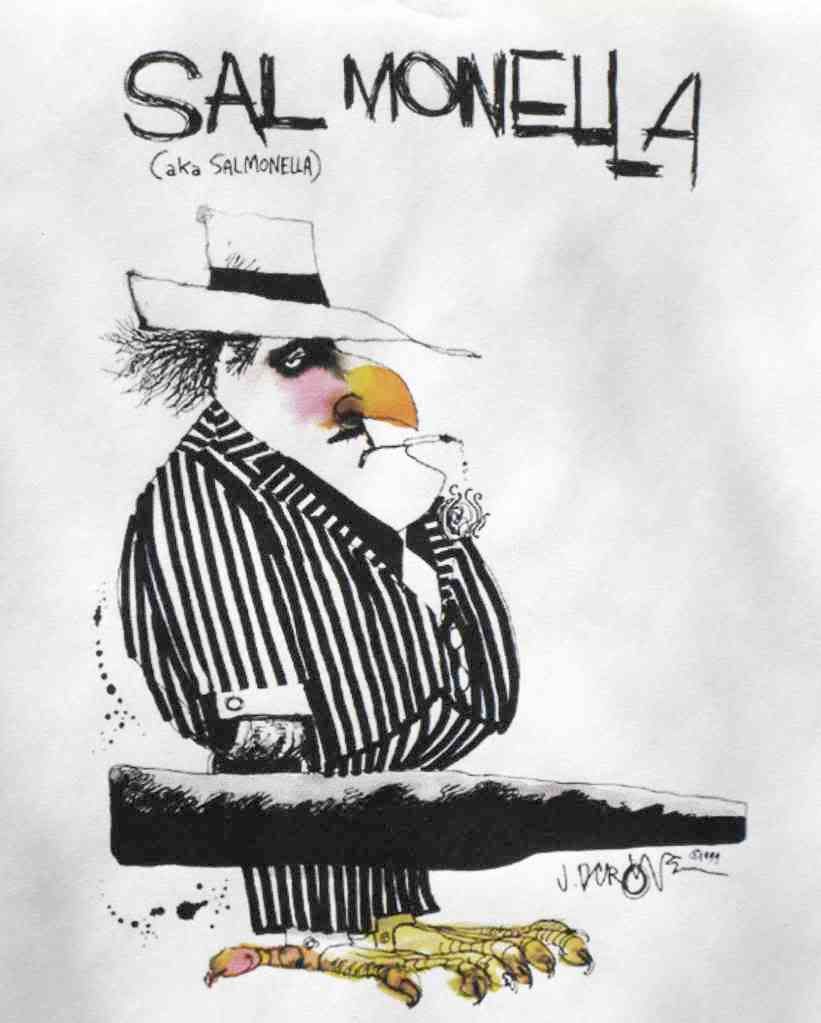
Salmonella,
E. coli and
Campylobacter.
Misconception #4. Dogs don’t get sick from bacteria and, therefore, can’t infect their human companions.Dog may be less susceptible than humans to becoming sick from
Salmonella, but they are not immune. And, just like Typhoid Mary, apparently healthy dogs can shed
Salmonella in their feces. Furthermore,
Salmonella isn’t the only pathogenic microbe that can infect dogs.
Campylobacter, which is prevalent in raw poultry, can also be carried by dogs. Parasites such as
Giardia can be spread from dogs to humans, too. I'll provide specific examples in Part 3 of this series.
Sorting through conflicting statements about health and safety issues can be both confusing and frustrating, especially when those statements are not backed up by independent scientific evidence. If you’d like to delve more deeply into the technical details, the links I’ve provided will give you a place to start.
Watch for Part 3 of this series, “Getting Down To Cases”, which will appear on Friday, March 14th.
 The Canadian Food Inspection Agency has alerted consumers to the presence of Salmonella in Rollover Pork Tenders Premium Dog Treats. One illness has been associated with this product.


















 Posts




