Showing posts with label food safety. Show all posts

Friday, December 10, 2010

The Great Food Safety Debate of 2010

*To-morrow, and to-morrow, and to-morrow,
Creeps in this petty pace from day to day,
To the last syllable of recorded time;

Continuing Resolution H.R. 3082 was approved by the U.S. House of Representatives on Wednesday (December 8th). It contains the appropriations for Fiscal Year 2011 (which began on October 1st), and the "corrected" version of the Food Safety Modernization Act. The House's action was reported to the Senate yesterday morning and should be voted on in the Senate next week.


And all our yesterdays have lighted fools
The way to dusty death. Out, out, brief candle!

Will the Senate pass H.R. 3082? If not, the government will run out of cash and have to pay its employees with lumps of coal instead.


Life's but a walking shadow, a poor player,
That struts and frets his hour upon the stage,
And then is heard no more.

What does the Food Safety Modernization Act accomplish?
  • It mandates increased frequency of inspections, but does not authorize the level of spending that FDA said it needed to fund the increased inspection activities.
  • It mandates a universal HACCP approach to food safety, but exempts small producers.
  • It mandates registration of food processing facilities, but exempts small producers.
  • It mandates improved tracing of high-risk foods through the distribution chain, but does not require disclosure to the public of the wholesale and retail destinations of recalled foods.
  • It provides FDA with the authority to collect fees, but only to cover the costs of re-inspections, recall activities, and administering the voluntary qualified importer program.
  • It provides FDA the authority to mandate a product recall, when there is a "...reasonable probability that an article of food...is adulterated...or misbranded..." and the responsible party does not voluntarily agree with a request from FDA to recall the item.
The Food Safety Modernization Act does all these things. In some ways, it will make FDA's job a bit easier. But it does not guarantee that the US food supply will be any safer, and it does not provide consumers with any more information on where recalled foods were served or sold than is available right now.


It is a tale
Told by an idiot, full of sound and fury,
Signifying nothing.

(*Soliloquy from Act V of Macbeth, by William Shakespeare)


If you would like to receive automatic email alerts for all new articles posted on eFoodAlert, please click here or submit your request using the sidebar link. Please include "subscribe eFoodAlert" in the subject line.

Monday, November 29, 2010

A Blogger's Food Safety Credo

I believe that every individual is entitled to a reliable supply of safe food and safe drinking water.


I believe that food producers, processors, distributors, transporters and handlers are morally, ethically and legally responsible for ensuring the safety of the food that passes through their hands.

I believe that the responsibility for producing and selling safe food does not vary with the size of the company.

I believe that both imported and domestically produced foods must meet the same high standards of safety.

I believe that legislators are duty-bound to develop and promulgate unambiguous food safety laws, and to update those laws as the situation and the science dictate.

I believe that legislators are duty-bound to provide government agencies with the regulatory tools and financial resources needed to enforce food safety laws.

I believe that government agencies and their personnel are morally and ethically responsible for rigorously enforcing all food safety laws and regulations.

I believe that companies and individuals who knowingly sell or supply contaminated food should be subject to prosecution for reckless endangerment and, if convicted, should be severely punished.

I believe that consumers are entitled to full, factual and prompt information on all food safety recalls and food-borne disease outbreaks.

I believe that consumers have a right to know where their food originated and what ingredients it contains.

I believe that consumers must accept responsibility for safely preparing, handling, and storing food at home.


Sadly, I also believe that we have a long way to go – both in the USA and elsewhere around the world – before my personal food safety credo becomes a reality.


If you would like to receive automatic email alerts for all new articles posted on eFoodAlert, please click here or submit your request using the sidebar link. Please include "subscribe eFoodAlert" in the subject line.

Tuesday, November 23, 2010

Senate Food Safety Debate Spawns Hysteria, Hyperbole & Half-Truths

It's time for a reality check

We want building codes to be enforced so that our houses and office buildings don't collapse.

We want municipalities to ensure that our drinking water is safe.

We want doctors, lawyers, architects and accountants to be certified competent before they are allowed to practice.

We want the government to make sure that the toys our children play with, and the vehicles they ride in, are safe – and we accept that the feds must have the authority to mandate a recall of unsafe toys or vehicles.

We want the FDA to protect consumers from adulterated, unsafe or substandard imported products.

But there's something about federal government regulation of domestic food producers and processors that evokes public paranoia.

During the recent Senate debate on the Food Safety Modernization Act ("S510") – and in the days following that debate – several people have replied to my blog posts by enunciating their fears and objections to this overdue overhaul of the FDA's mandate. Let's examine some of these.

Excerpted from an Anonymous reader's comments, posted November 19th:
"This would give Big brother the power to regulate the tomato plants in your backyard. It would grant them the power to arrest and imprison people selling cucumbers at farmer's markets."

"This tyrannical law puts all food production (yes, even food produced in your own garden) under the authority of the Department of Homeland Security."

"This law would also give the U.S. government the power to arrest any backyard food producer as a felon (a "smuggler") for merely growing lettuce and selling it at a local farmer's market."

"It also sells out U.S. sovereignty over our own food supply..."

"It would criminalize seed saving (http://foodfreedom.wordpress.com/20...), turning backyard gardeners who save heirloom seeds into common criminals."

From another Anonymous reader, also posting on November 19th:
"The goals of this bill is to illegalize the growning (sic) and production of [food] unless licensed by the federal government. Any license given can be revoked. And it is highly unlikely that anyone that wants to grow a family garden will be able to get licensed."

From Greg, who posted on November 19th:
"Harkin thinks he is a GOD. This bill needs to be defeated like Satin (sic) was. Video of Harkin claiming he is God. http://www.youtube.com/watch?v=EdAPuUkxZbQ
"

Excerpted from the comment of an Anonymous reader, posted November 22nd:
"There are plenty of government agencies already in place to deal with food safety, and they continuously drop the ball. When the White House abolishes all of those existing US food agencies, then maybe I would support an alternative."

From Harry Hamil, posted November 19th:
"...very few of those rules will improve food safety because they will be so strongly shaped by a legislated HACCP-style approach that Dr. William Sperber showed way back in December 2002 doesn't deliver what it promises."

Now for the reality check:
  1. Backyard gardeners are NOT subject to the provisions of S510. The amended act that will be taken up by the Senate on November 29th states explicitly that the section on produce "...shall not apply to produce that is produced by an individual for personal consumption." Big Brother will not be confiscating your backyard tomato plants, people. And you won't be needing a license to grow your cucumbers.
  2. Small farmers who market directly to consumers – at the farm gate or via farmer's markets – will be exempt if their revenue from the sale of food is less than $500,000 per annum. This, too, is in the amended version of S510.
  3. There is nothing in S510 that prohibits seed saving. The word "seed" is not even mentioned in S510.
  4. Hamil's reference to Dr. Sperber's paper is incomplete, and implies that Sperber has determined HACCP to be ineffective. What Dr. Sperber actually said was:
"Food safety is not synonymous with HACCP. Food Safety is HACCP plus prerequisite programs. It is time for us to stop talking about "Farm to Table HACCP". Rather, we should talk about "Farm to Table Food Safety." This essential change in emphasis will allow us to focus on effective interventions and CCPs to protect the public health and it will eliminate the false expectations that HACCP alone can provide food safety assurance."

The HACCP provisions in S510 apply to those activities that benefit from HACCP, namely, manufacturing, packing, processing and warehousing. The "... production and harvesting of fruits and vegetables that are raw agricultural commodities ..." will be approached through the development of "...updated good agricultural practices and guidance for the safe production and harvesting of specific types of fresh product." This is entirely consistent with Dr. Sperber's philosophy.

As for abolishing all existing US food agencies, I don't think that the reader would like to take this country back to the days before there were any food safety laws – when slaughterhouses operated as described in Upton Sinclair's "The Jungle"; when food adulteration was common; and when there was no Pasteurized Milk Ordinance. Personally, I would like to see a single agency at the federal level with responsibility for all food safety inspection and enforcement. But abolishing the existing agencies without simultaneously creating a replacement for them is neither sensible nor practical.

The Food Safety Modernization Act is not perfect. It is a compromise between what FDA believes that it needs and what the politicians and the public are prepared to accept (and pay for). Passage of S510 does not guarantee an immediate, drastic reduction of the national incidence of food-borne disease.

But it will help.


If you would like to receive automatic email alerts for all new articles posted on eFoodAlert, please click here or submit your request using the sidebar link. Please include "subscribe eFoodAlert" in the subject line.


P.S. Please watch the video of Harkin – the video that Greg says is "Harkin claiming he is God" – and draw your own conclusions.

Friday, November 19, 2010

US Senate's Convoluted Food Safety Roadmap

Senior legislative body suffering from motion sickness

As a layperson who is trying to follow the so-called progress of the Food Safety Modernization Act ("S510") through the Senate, I can only echo Yul Brynner in The King and I. "It's a puzzlement!"

Senate Majority Leader Harry Reid (D-Nevada) tried to bring S510 to a vote this week, to no avail. For those who are still scratching their collective heads over the significance of the votes taken on November 17th and 18th, here's what happened.

First, there was a motion to proceed with the consideration of S510.

Next, there was a motion to invoke cloture in order to limit debate on the motion to proceed with S510. The motion to invoke cloture was approved on November 17th, with 74 senators voting in favor.

Following some additional debate on the original motion to proceed, the Senate voted yesterday (November 18th) to proceed with the bill – on November 29th, after the Thanksgiving recess. The vote was 57 in favor and 27 opposed, with 16 senators not voting.

What will happen on November 29th? This is what has been agreed to, in the Senate's own words:
Ordered, That at 6:30 p.m. on Monday, November 29, 2010, the Senate proceed to vote on the motion to invoke cloture on Amdt. No. 4175 (sic), a substitute amendment to S. 510, a bill to amend the Federal Food, Drug, and Cosmetic Act with respect to the safety of the food supply; provided, that if cloture is invoked on the substitute amendment, then all post-cloture time be yielded back except for the time specified in this agreement with the debate limits as specified:

Johanns motion to suspend with respect to Amdt. No. 4702 and Baucus motion to suspend with respect to Amdt. No. 4713—60 minutes total debate equally divided and controlled between Senators Johanns and Baucus;

Coburn motion to suspend with respect to Amdt. No. 4696 (substitute), and Coburn motion to suspend with respect to Amdt. No. 4697 (earmarks)—4 hours total debate equally divided between Senators Coburn and Inouye.

Ordered further, That upon the use or yielding back of time the Senate proceed to vote with respect to the motions to suspend in the order listed:
Johanns; Baucus; Coburn (earmarks); Coburn (substitute).

Ordered further, That if any motion is successful, the Senate vote immediately on the amendment and that upon disposition of all motions and amendments, no further motions or amendments be in order and the substitute amendment, as amended, if amended, be agreed to; the bill, as amended, be read a third time; and that after reading the pay-go statement with respect to the bill, the Senate proceed to passage of the bill and the cloture motion with respect to the bill be withdrawn.

Ordered further, That the mandatory quorums required under Rule XXII be waived. (Nov. 18, 2010.)

And this means?
  • Amendment 4715 (there's a typo in the Senate wording) is the latest compromise version of S510, including exempting small producers from some of the provisions of the Act (the Tester Amendment). The first step will be a cloture vote on Amendment 4715. If this fails, all bets are off.
  • The Senate has agreed to consider competing amendments proposed by Senators Johanns (R-Neb) and Baucus (D-Mont). These amendments (4702 and 4713, respectively) seek to repeal a provision of the health care law, which was passed a few months ago. This has nothing to do with food safety, but the senators want to piggyback the repeal onto S510.
  • The Senate has agreed to consider two Amendments (#4696 and 4697) proposed by Senator Coburn (R-Okla). The first of these pulls most of the teeth out of S510 – maybe it's good that the Senator is a doctor, and not a dentist! Amendment #4697 declares a moratorium on "earmarks" for the 2011 through 2013 fiscal years – nothing to do with food safety.
  • Finally, if everything goes according to plan, there will be a vote on the Food Safety Modernization Act.

If S510 passes the Senate, it will then return to the House of Representatives for another vote (since the Senate version is different from the bill passed by the House more than one year ago). Assuming that the House accepts the Senate version of the bill without further amendment before the end of this year, the bill with go to the President for signature.

Will it pass? My gut says "yes."

Will it have been worth the effort? I don't know – It's a puzzlement!

If you would like to receive automatic email alerts for all new articles posted on eFoodAlert, please click here or submit your request using the sidebar link. Please include "subscribe eFoodAlert" in the subject line.

Thursday, November 18, 2010

ALERT: Food Safety Bill Debate Proceeds

Senate votes 57 to 27 in favor of proceeding to Food Safety Modernization Act.

Is Senator Coburn (R-Okla) Trying To Torpedo S510?

Senator from Oklahoma wants to vote earmark amendment as part of food safety debate

What will it take for Coburn to agree to pass Food Safety Modernization Act?

Tom Harkin (D-Iowa), Chairman of Senate Committee on Health, Education, Labor & Pensions says:
1. We removed section on increasing FDA staff levels
2. We reduced $$$ authorization
3. We agreed to amendment on reducing duplication among agencies

Harkin says:
"This is a food safety bill...ready to go...compromises in place. Not the time to debate earmarks."

Harkin says:
"Why am I so passionate? Because people are dying."

Harkin says:
"...send hopeful message to families before Thanksgiving."

Harkin says:
Food Safety Modernization Act "...has no politics..."

Harkin says:
"If we lose this....it will be very hard to put this back together again."


Senator Tom Coburn will do whatever it takes to block passage of the Food Safety Modernization Act. And he will succeed, no matter how many other Senators – and how many US families – want the bill to pass!!!!


If you would like to receive automatic email alerts for all new articles posted on eFoodAlert, please click here or submit your request using the sidebar link. Please include "subscribe eFoodAlert" in the subject line.

Saturday, October 16, 2010

Recall Details For Abbott's Similac And Isomil Infant Formulas

Original article posted September 24, 2010; updated October 16, 2010

Abbott has recalled a number of Similac and Isomil infant formula powders after evidence of a "...small common beetle was found in the product produced in one production area of a single manufacturing facility." That facility is located in Sturgis, MI.

According to information provided by Abbott in response to an email request, following is the official alphabetical list of countries and territories affected by this recall: Antigua, Aruba, Bahamas, Barbados, Bermuda, British Virgin Islands, Cayman Islands, Curaçao, Grenada, Guam, Guyana, Haiti, Jamaica, Puerto Rico, St. Eustatius, St. Lucia, St. Maarten, St. Vincent, Surinam, The Grenadines, Trinidad & Tobago, Turks & Caicos, U.S.A., and U.S. Virgin Islands.

The Food and Drug Authority of Saudi Arabia has learned that Abbott shipped 4 cartons (24 cans/carton) of recalled Similac powder to private customers in the Kingdom.

The Canadian Food Inspection Agency is monitoring the recall situation and advises that, to the best of its knowledge, none of the recalled products were imported into Canada.

The Taiwan Department of Health also confirms that none of the recalled infant formula powders were shipped to Taiwan.

Abbott did not provide a list of retailers who were supplied with the recalled infant formula powders.

Following is a complete list of recalled Similac and Isomil infant formula products. These products are sold in various package sizes. Abbott has provided a search feature on its recall web site, so that consumers can determine whether the product they have purchased has been recalled. The affected lot numbers also can be found on the 38-page list released by Abbott. FDA has posted a searchable database page, and the California Department of Public Health has posted a complete list of stores in the state where the recalled products were sold.
  • Go & Grow Milk Early Shield Powder
  • Go & Grow Milk with Early Shield
  • Go & Grow Milk Powder
  • Go & Grow Soy Early Shield Powder
  • Go & Grow Soy Powder
  • Isomil Advance Powder
  • Isomil Advance Early Shield Powder
  • Isomil Powder
  • Similac Advance Early Shield Powder
  • Similac Advance Early Shield Powder Can
  • Similac Advance Early Shield Powder Luxor
  • Similac Advance Iron Powder LCP
  • Similac Advance LCP with Iron Powder
  • Similac Advance Powder
  • Similac Advance Powder Luxor
  • Similac Go & Grow Powder W/LCPs
  • Similac Go & Grow Powder Luxor
  • Similac Go & Grow Soy W/lcps Powder
  • Similac Organic Powder
  • Similac Organic Powder Luxor
  • Similac Sensitive Early Shield Powder
  • Similac Sensitive Powder Luxor
  • Similac Sensitive R.S. Powder
  • Similac Sensitive Sales
  • Similac Sensitive with Iron Powder
  • Swi Advance Powder-Wic

The following US retailers carried one or more of the recalled items in at least one of their store locations:
  • Albertsons
  • Bel Air
  • Big Y World Class Market
  • BJ's Wholesale Club, Inc.
  • Bloom
  • Bottom Dollar Food
  • Brookshire's food & pharmacy
  • Costco
  • CVS
  • Food City
  • Food Lion
  • Fresh & Easy
  • Giant Eagle
  • Giant Food, LLC
  • Giant Food Stores
  • Harveys
  • Ingles Markets Inc.
  • Kinney™ Drugs
  • K-Mart
  • Kroger
  • Lucky
  • Longs Drug
  • Meijer
  • Nob Hill Foods
  • Nugget
  • Price Chopper
  • Publix
  • Raley's
  • Ralphs
  • Rite Aid
  • Reids
  • Safeway
  • Sam's Club
  • Save Mart
  • ShopRite
  • Stater Bros
  • Stop & Shop
  • Super 1 Foods
  • Target
  • Top food & drug
  • Toys-R-Us/Babies-R-Us
  • Vons
  • Walgreens
  • Walmart Stores
  • Wegmans
  • Winco

In addition, the following states report having distributed recalled infant formula powder under their Women, Infants, and Children Nutrition (WIC) programs:

Colorado has advised its residents that none of the recalled infant formula was distributed through the Colorado WIC program. Colorado provides the Enfamil product line, which is not manufactured by Abbott.

The information in this article will be updated as more information becomes available.


If you would like to receive automatic email alerts for all new articles posted on eFoodAlert, please click here or submit your request using the sidebar link. Please include "subscribe eFoodAlert" in the subject line.

Tuesday, September 28, 2010

American Fast Food Abroad

Oasis for homesick travelers, or recipe for disaster?

Speaking from personal experience, footsore international travelers – even those who don't patronize fast food restaurants at home – celebrate the sighting of a pair of golden arches as jubilantly as Stanley marked his first encounter with Dr. Livingstone.


After weeks of sampling exotic food in Southeast Asia, finding an almost-familiar food outlet is worth memorializing.


Fast food chains based in the industrialized world face special difficulties when they expand into less developed regions. Cultural differences, food supplies, sanitation issues and the availability of safe drinking water all present challenges, which must be surmounted if a multinational company is to maintain a consistent and recognizable standard of product and service.


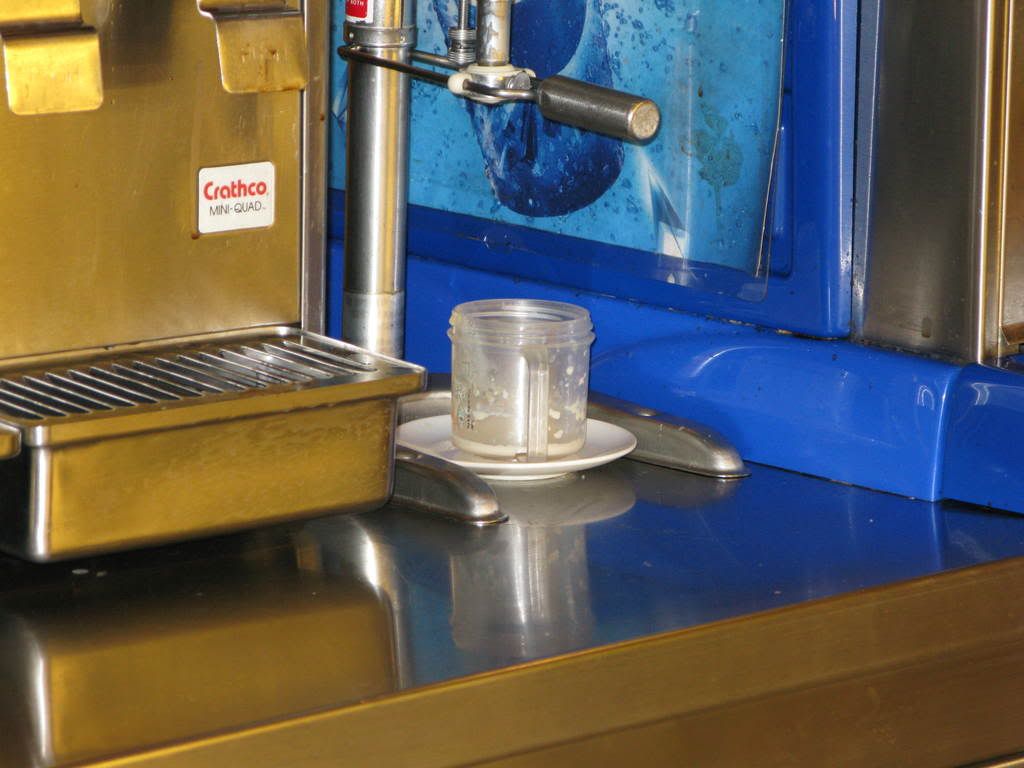
I once had the chance to experience, first-hand, the impact of cultural practices on Dunkin' Donuts' Bangkok operations. As I reported in 2008, the chain's corporate management reacted promptly and positively when I advised them of my observations relating to the dispensing of coffee cream (please click on the live link for the full story).


I was reminded of these issues on the weekend, after reading in Today's Zaman about the disappearance of 160,000 hamburger patties (roughly 11 tons of meat) that had been destined for Burger King in Turkey, but which were rejected due to contamination with Listeria and Salmonella.

The hamburger patties were produced by TT Gida, and shipped to Fasdat Gida last spring for delivery to Burger King. But Fasdat Gida claimed that the meat was contaminated, cancelled its contract with TT Gida, and sent the 160,000 hamburger patties to Zeybek Solid Waste Center for safe disposal. And that should have been the end of the story.

After learning what Fasdat Gida had done with the meat, TT Gida (the manufacturer) tried to locate it at the Waste Center. The 160,000 patties were, however, nowhere to be found. When contacted by the Agriculture Ministry, Zeybek claimed to have shipped the hamburgers to a Kangal dog farm in Bursa. The farm's manager reported that all of the meat was fed to his 55 dogs during the two month period between May 5 and July 7.

The Agriculture Ministry did the math and decided that it was highly unlikely for 55 dogs to have consumed what amounted to more than 3,300 pounds of meat each per day for two months.

So where was the missing beef? The Turkish government has concluded that it probably was sold – through discounters – for human consumption. The incident is now under investigation by a public prosecutor. And Fasdat Gida, the intermediate company that was responsible for supplying hamburger patties to Burger King is under suspicion; one of its warehouses was operating without a license.

The next time you get excited about a familiar pair of golden arches (or any other familiar fast food logo) in a strange city, remember that the logo might be "western" but the food is surely local.


If you would like to receive automatic email alerts for all new articles posted on eFoodAlert, please click here or submit your request using the sidebar link. Please include "subscribe eFoodAlert" in the subject line.


Wednesday, September 22, 2010

Ten Steps To A Safer Food Supply: Part Three

"Please make our food supply safer."
- Carol Lobato, Salmonella Enteritis victim, September 22, 2010


The House Subcommittee on Oversight and Investigations heard today from two of the more than 1600 victims of the Salmonella Enteritis outbreak, both of the companies whose eggs were linked to that outbreak, and the Principal Deputy Commissioner of the FDA. The Subcommittee chose not to hear from USDA, whose Agriculture Marketing Service is responsible for egg-grading activities at both company's operations.

Sarah Lewis (Freedom, CA) and her sister were two of the earliest recorded victims of the outbreak. They both became ill last May, after eating a custard tart served during Sarah's sister's college graduation banquet. Sarah was hospitalized twice – including three days in a coronary critical care unit – and developed colitis as a result of a secondary Clostridium difficile infection. Sarah remains a carrier of Salmonella Enteritis and continues to suffer aftereffects of her illness.

Carol Lobato (Littleton, CO) is 77 years old. On July 10th, Carol and her husband Ed took their grandson Drew to dinner at The Fort Restaurant in Morrison, Colorado. All three shared an appetizer of rattlesnake cakes. Carol, who suffers from rheumatoid arthritis and takes immunosuppressive medications, developed septic shock and was admitted to hospital. Ed and Drew also were ill, but not as severely as Carol, who remained in hospital for five days. Salmonella Enteritidis – an exact DNA match to the strain recovered at Wright County Egg – was found both in Carol's bloodstream and in her intestines.

Sarah Lewis and Carol Lobato suffered life-threatening illnesses through no fault of their own. All they did was to enjoy a celebratory meal with their families.

In the first two parts of this series, I proposed six steps that I believe would improve the ability of federal food safety agencies – mainly FDA and USDA – to carry out their responsibility to US consumers. Following are an additional four steps that can be taken to answer Carol Lobato's plea and improve the safety of the US food supply.

Step 7. Pass and implement mandatory recall authority for FDA and USDA
The Canadian Food Inspection Agency has mandatory recall authority. So does the UK Food Standards Agency. So does Food Standards Australia. So do the food regulators in a number of other countries.

In the United States, the Consumer Product Safety Commission has mandatory recall authority. USDA does not, but can "encourage" a recall by threatening to withdraw its inspector from a plant that it oversees. FDA has no such means of persuasion. Its only rapid response recourse in the absence of a company's cooperation is to issue a Health Alert – as it did earlier this year to warn pet owners about dog treats that were at risk of being contaminated with Salmonella.

In fact, Canada, the UK and Australia rarely have to invoke their recall authority. The mere existence of this provision is enough to ensure cooperation on the part of the food manufacturer, processor or distributor whose product safety has been called into question.


Step 8. Pass and implement traceability for all food products
One of the most problematic parts of a food outbreak investigation is tracing the origin and distribution of a suspect food. Unless companies are required to maintain complete and detailed records – and make those records available to regulators in the event of a product contamination issue – a contaminated food cannot be tracked back to its source or forward to its destination. Without effective traceability, contaminated food inevitably will remain on the market and in the hands of consumers.


Step 9. Increase FDA's budget for routine inspections of domestic food processors
According to FDA's Principal Deputy Commissioner, Dr. Joshua Sharfstein, who testified at the Egg hearing, the agency has the wherewithal to carry out approximately 18,000 inspections annually. That sounds like a lot of inspections, except that there are 150,000 facilities in the US under FDA jurisdiction. FDA simply must be given the money to do its job, if we are to see any significant reduction in the number of foodborne outbreaks in the United States.


Step 10. Introduce steep, mandatory penalties – including prison sentences – for egregious or repeat offenders of food safety laws
Malefactors such as Peanut Corporation of America's Stewart Parnell or Wright County's DeCoster should not be able to extricate themselves with a formal apology and a slap on the wrist.


My Ten Steps are not the entire answer to the problems that beset the food safety system in the United States. They are just the first steps in a long journey back to a food system that US consumers can depend upon and that members of the food industry can be proud of.


If you would like to receive automatic email alerts for all new articles posted on eFoodAlert, please click here or submit your request using the sidebar link. Please include "subscribe eFoodAlert" in the subject line.

Ten Steps To A Safer Food Supply: Part Two

"There is no more basic role for government than ensuring safe food..."


The Food Safety Modernization Act (S. 510) is not quite ready to be embalmed, according to Alicia Mundy of the Wall Street Journal, but it is definitely on life-support.

The bill faces opposition from Senator Tom Coburn, who wants to know how the Administration plans to cover the estimated $1.4 billion dollar cost of improving the country's food safety system. Small farmers are worried about paying for the improved sanitation standards and product tracing requirements contained in the legislation. And California Democratic Senator Dianne Feinstein wants to add a provision to ban bisphenol A in food packaging.

All in all, not a promising situation.

In Part One of this series, I proposed three steps towards putting food safety on a sounder footing in the United States. Here are some additional ideas:

Step 4. "Routine" does not make it right
USDA egg graders working at Wright County Egg wrote daily sanitation reports on conditions at the farm, but didn't notify FDA of the unsanitary conditions because "the conditions at the egg plant packing facilities were routine," according to a Wall Street Journal report.

Inspectors and graders working at USDA and FDA must be trained to view with alarm any conditions – "routine" or not – that put the health of the consumer at risk. These individuals must also be assured by senior management at both agencies that anyone who blows the whistle on deviations from food safety laws and regulations will be protected from reprisals.


Step 5. Implement existing food safety laws that have been languishing on the shelf
Congress passed an updated Sanitary Food Transportation Act in 2005, instructing the Secretary of Health and Human Services to ". . . issue regulations setting forth sanitary transportation practices . . . in food transport." On April 30, 2010, FDA finally published an Advance notice of proposed rulemaking to solicit data and information from the food transportation industry. That's five years of inaction – five years of unnecessarily exposing the country's food supply to possible insanitary or improper transportation and storage conditions.

There is simply no excuse for procrastination. Federal agencies must promptly begin the process of implementing food safety legislation as soon as it has been signed into law.


Step 6. Interpret existing food safety laws with a bias in favor of food safety
The Federal Food, Drug, and Cosmetic Act states that a food is adulterated if (among other things):
  • it bears or contains any poisonous or deleterious substance which may render it injurious to health;
  • it consists in whole or in part of any filthy, putrid, or decomposed substance; or
  • it has been prepared, packed, or held under insanitary conditions whereby it may have become contaminated with filth, or whereby it may have been rendered injurious to health.
The Federal Meat Inspection Act defines carcasses, parts of carcasses, meat, or meat food products as adulterated if (among other things):
  • it bears or contains any poisonous or deleterious substance which may render it injurious to health;
  • it consists in whole or in part of any filthy, putrid, or decomposed substance or is for any other reason unsound, unhealthful, unwholesome, or otherwise unfit for human food; or
  • it has been prepared, packed, or held under insanitary conditions whereby it may have become contaminated with filth, or whereby it may have been rendered injurious to health.

FDA and USDA have the authority under these existing laws to act decisively when confronting contaminated food. To dither over which pathogens should be considered adulterants and which ones should be winked at is to shortchange the people that these agencies are in business to serve. What part of "injurious to health" do these agencies – most notably, USDA – not understand?


Please watch for Part Three of this series, where we'll continue our walk down the road to safer food.


If you would like to receive automatic email alerts for all new articles posted on eFoodAlert, please click here or submit your request using the sidebar link. Please include "subscribe eFoodAlert" in the subject line.

Tuesday, September 21, 2010

Ten Steps To A Safer Food Supply: Part One

"Protecting the safety of our food and drugs is one of the most fundamental responsibilities government has, and . . . it is a responsibility that I intend to uphold in the months and years to come."


Eighteen months after President Obama made this commitment, Senate Majority Leader Harry Reid announced the death of the Food Safety Modernization Act (S. 510).

S.510 incubated in the Senate for more than a year, taking a back seat to health care reform, financial system reform, and stimulus packages. While it languished, the US food industry logged 85 safety recalls – most of them due to contamination by Salmonella and Listeria monocytogenes. Nine of the recalls were linked to 1,850 reported illnesses (data supplied by the U.S. Public Interest Research Group, the Center for Science in the Public Interest and the consumer Federation of America).

The time for wringing our collective hands over the sorry state of the US food safety system is past. It is time to act. Here's what I propose:

Step 1. Establish an on-line clearing house where consumers can report food safety problems
Consumers are the first to suffer the consequences of unsafe food. When an individual has a problem with a food, he or she should not have to figure out who has jurisdiction over that specific item. We need a single on-line consumer complaint portal. Any consumer should be able to access and complete a fill-in form detailing the food safety issue, and be confident that the complaint will be directed automatically to the appropriate federal, state or local agency for follow-up.

The portal also will serve as a means of tracking trends in food safety complaints, and help FDA and USDA to evaluate high risk foods and food processors for priority investigation. In addition, consumers would be able to flag instances of recalled foods that remain on store shelves in their areas.

The complaint portal must be widely publicized. Any organization with an interest in food safety – news outlets, consumer groups, state and local governments – would be encouraged to maintain a live link to the complaint portal on their web sites.


Step 2. Initiate full disclosure of retail distribution for all Class 1 (high risk) food recalls.
Last month, California – a state deeply mired in debt – published a list of all retailers, restaurants, nursing facilities and food service operations that were supplied with recalled eggs. The list, which was last updated September 14th, is 198 pages long. USDA's Food Safety and Inspection Service publishes a distribution list for all Class 1 recalls, but excludes restaurants, food service operations and other facilities that serve food rather than sell retail packages. FDA does nothing to tell consumers where recalled food was sold, except for providing a list of states.

FDA and USDA should immediately implement a full retail distribution disclosure policy for all Class 1 recalls. This does not require any new legislation. There is no valid excuse to withhold this information from the public.

In addition to full public disclosure, FDA and USDA should seek the authority to require that public recall notices be posted by any retailer, restaurateur or food service operator who was supplied with a recalled product. The notices should be posted prominently adjacent to the shelf or refrigerated/freezer case where the product had been displayed (in a store or cafeteria), and also posted at the entrance to each establishment.


Step 3. Disclose the contents of all food facility inspection reports
FDA discloses the contents of its "483" food facility inspection reports when the agency judges that there is sufficient interest to warrant the disclosure. Other reports only are released in response to a Freedom of Information Act request. Such requests must be made in writing (no email requests allowed), may take months to process, and must be paid for by the individual or organization that makes the request. USDA does not release any inspection reports, except in response to Freedom of Information Act requests.

FDA and USDA should both implement full disclosure of all inspection reports (redacted to remove commercial proprietary information, as FDA now does). The public has the right – and the need – to know which companies are doing their best to produce safe food, and which ones are just scraping by.


Please watch for Part Two of this series, where we'll take a few more steps down the road to safer food.


If you would like to receive automatic email alerts for all new articles posted on eFoodAlert, please click here or submit your request using the sidebar link. Please include "subscribe eFoodAlert" in the subject line.

Monday, September 20, 2010

A Recipe For Contaminated Food

How the USA went from the "world's safest food supply" to third largest source (after China and Turkey) of food safety notifications

Once upon a time, the United States might have had the world's safest food supply. But that was long ago.

Europe's Rapid Alert System for Food and Feed (RASFF) Annual Reports show very clearly just how badly the safety of food produced or processed in the USA has deteriorated. One of the tables in each Annual Report ranks safety notifications by Country of Origin. In 2002 (the first year for which an on-line report is available), the United States ranked 15th, with 25 notifications. China was in first place, with 147.

The USA managed to stay out of the top ten through 2005. Then, in 2006, the country vaulted into 4th place. Only China, Turkey, and Iran posted more RASFF food safety notifications than the US that year. Nor was this a one-year statistical blip. Since 2006, the United States has maintained its position among the top five countries of origin for food safety notifications. In 2009, only China and Turkey registered a higher number.

It takes hard work and careful thought to destroy a safe food supply. The US achieved this by doing all of the following – and more.

#1. Cutting FDA staff and reducing the number of inspections.
"Our study found that 56 percent of food facilities that were subject to FDA inspection went 5 or more years without an FDA inspection. If FDA does not routinely inspect food facilities, it is unable to ensure that these facilities are complying with applicable laws and regulations and that the food handled by these facilities is safe. Except in a few instances, there are currently no specific guidelines that govern the frequency with which inspections should occur.
Our study also found that the number of food facility inspections has declined, even as the number of food facilities has increased. In FY 2004, FDA inspected more than 17,000 facilities; in FY 2008, this number dropped to fewer than 15,000. During the same period, the number of food facilities subject to FDA inspection increased from about 59,000 to almost 68,000 facilities. We also identified a decline in the number of high-risk facilities inspected by FDA.
FDA officials attributed the decline in inspections primarily to a significant decrease in staffing levels that resulted from funding cuts. These officials noted that between 2003 and 2008, FDA lost almost a quarter of the staff that performs food facility inspections. They also noted that many of those losses came from the ranks of FDA’s most experienced employees."

#2. Spreading and overlapping responsibility for food safety oversight

#3. Keeping consumers in the dark about recalled products
  • USDA posts a retail distribution list for recalled products under its jurisdiction; however, the list does not include restaurants or food service establishments. FDA does not provide any retail distribution information, unless a food processor includes that information in the recall notice of its own volition. This half-baked recall notification system ensures that recalled foods will remain in the hands of consumers as long as possible.

#4. Frittering away resources on finished product testing
  • Testing finished products is a useful way to obtain a snapshot of the overall safety of the food supply. But it's a lousy way to ensure safe food. Using safe ingredients, maintaining a sanitary food processing operation, and paying careful attention to correct processing, handling, storage and transport conditions is the only way to ensure a safe food supply.

#5. Avoiding action until a problem becomes a crisis
  • We've learned that USDA egg graders were told of the unsanitary environment at Wright County Egg and did nothing, because the conditions were considered to be routine.

#6. Allowing animal waste to contaminate the environment
  • No one took effective action when E. coli O157:H7 first appeared in dairy cattle. We allowed it to spread in feedlots. As a result, the pathogen percolated into the soil and has contaminated some of the nation's most sensitive agricultural zones, including California's Salinas Valley. Now we are contending with the consequences – contaminated leafy green vegetables.

#7. Procrastinating on implementation of new rules and regulations
  • Congress passed the Food Safety Transportation Act in 2005. FDA finally began the rule-making process in April 2010.
  • FDA closed the final comment period for its Egg Safety Rule in July 2005. The Final Rule was not promulgated until July 2009 and went into effect for the largest producers in July 2010.

Following this recipe will enable any country to reduce the safety of its food supply to equate the current status in the United States.

I'll be offering my suggestions for improving the US food safety situation in a separate article.


If you would like to receive automatic email alerts for all new articles posted on eFoodAlert, please click here or submit your request using the sidebar link. Please include "subscribe eFoodAlert" in the subject line.


Sunday, September 12, 2010

Ella's Kitchen: PR Primer Out Of The Mouths Of Babes

UK baby food company shows how to handle a product withdrawal

Ella's Kitchen, a UK-based organic baby food company, initiated a product withdrawal on September 3rd, after learning about a microbial spoilage problem. The drinking straws included with the packaging of certain batches of their stage 1 baby foods were contaminated with a non-pathogenic fungus by the name of Aureobasidium.

Ella's notified its customers of the problem via Twitter on September 3rd – the same day it notified retailers. The official product withdrawal notice, dated September 9th and published on the Food Standards Agency web site, provided details of product varieties, batch codes, and expiration dates that one expects to see in this type of communication.


What else did the company do that others can learn from?

1. Ella's Kitchen posted on its web site a lucid explanation for its product withdrawal, clear instructions for contacting the company, and an apology for the problem – reproduced below:
A small number of people have contacted us and let us know about an issue with some of our Carrots, Apples + Parsnips stage one baby food pouches.

We’ve looked into this and found that 3 of our products produced at one isolated factory have been subject to natural product spoilage, occurring inside the straw of the pouches. Ella’s products that are sold in the USA are not made in this factory and are not affected by this issue.

This has affected our Carrots, Apples + Parsnips; Strawberries + Apples; and Apples + Bananas stage 1 baby food.

Whilst we believe that this spoilage is completely harmless, we are currently investigating thoroughly, and this process will take some time to analyse fully. In the meantime, while we carry out our investigations into the exact cause, and because we believe that mums, dads and hungry little ones should be enjoying all of our products in tip top condition, we have decided to withdraw all products produced at this one factory, until we know what’s gone wrong. This includes the above affected products, plus our ‘Yellow One’ smoothie fruit snack as a precautionary measure.

The batches we are withdrawing are limited to products with the letters ‘CAP’, ‘SA’, ‘YO’ and ‘AB’ in the batch code and with the best before dates of April 11, May 11, June 11 and July 11 (both found on the back of pack).

If you have one of these pouches and you'd like to get in touch, then we'd love to hear from you by:
  1. Contacting us by email on this address: customercare@ellaskitchen.co.uk
  2. Ringing our customer care line on this number: 0845 26 25 221. We’ll be here to answer calls Mon – Fri 9 –5pm. If you leave a message we’ll get back to you on the next working day.
  3. Or, you can pop the pouch in an envelope. All you need to write on the envelope is “Freepost Ella’s Kitchen”. Just make sure you include your name, address and telephone number so that we can get in-touch with you and refund your money.

We can assure you that no other Ella’s pouches are affected, having all been made in another factory to Ella’s high standards.

We’d like to say a big thank you to those mums and dads who have taken the time to get in touch and let us know about this. We’re really sorry to have let you down on this occasion. It’s really important to us that we make sure you always enjoy our products in tip top condition.

If you would like to chat to us about this or any of our products please do give us a ring on 0845 26 25 221 or email: customercare@ellaskitchen.co.uk

2. The company kept its customers informed of the outcome of its investigation into the problem with this follow-up, posted on its web site one week later:
It’s been a week since we withdrew some batches of our products from the supermarkets. We wanted to apologise for the inconvenience and worry this may have caused, and also to let you know what we have been doing.

We informed all of the supermarkets on 3rd September to withdraw all affected batches from sale. We had confirmation that this has been actioned and communicated to all stores. From the 4th September, we have been delivering to stores Ella’s pouches that are made in another factory and therefore are not affected by this issue and can be enjoyed as Ella’s foods should be.

We also wanted to share with you that in line with our ethical approach to food production, we have been really busy investigating further. Our own technical team have been at the one factory where these batches were made, along with an independent external expert. Detailed analysis has also been completed by 3 independent experts, all returning the same conclusion that the spoilage is a naturally occurring yeast which is completely harmless. This yeast is present in the environment around us and is for example on all fresh fruit and vegetables.

We have also been working very closely with our local Environmental Health Department and the Food Standards agency (FSA); who are both fully satisfied with both our investigations and conclusions.

If you have one of these pouches, please email us the full batch code and best before date along with your name and address to: customercare@ellaskitchen.co.uk for an Ella’s Kitchen product refund voucher.

We don’t need you to post us back any of the pouches, as we have now completed our investigations on these. We can assure you that no other Ella’s pouches are affected, having all been made in another factory to Ella’s high standards.

We’d like to say a big thank you to those mums and dads who have taken the time to get in touch and let us know about this. We’re really sorry to have let you down on this occasion. It’s really important to us that we make sure you always enjoy our products in tip top condition.

If you would like to chat to us about this or any of our products please do get in touch on 0845 26 25 211 or email customercare@ellaskitchen.co.uk.

3. Someone at Ella's Kitchen took the time to make certain that the complete message was spread far and wide, as shown by this comment posted to the September 9th Recall Roundup:
We wanted to apologise for the inconvenience and worry this may have caused you. We take any concerns that mums and dads have very seriously. We have popped some useful information on our website today that we’d love you to read and hope you find it reassuring: www.ellaskitchen.co.uk.


Contrast this with the brush-off that some consumers have received from certain egg producers during the nationwide Salmonella Enteritidis outbreak and egg recalls that have roiled the US egg industry in recent weeks.

Ella's Kitchen has produced a public relations primer that truly is out of the mouths of babes.


If you would like to receive automatic email alerts for all new articles posted on eFoodAlert, please click here or submit your request using the sidebar link. Please include "subscribe eFoodAlert" in the subject line.

Thursday, July 29, 2010

Outbreaks and Alerts: July 29, 2010

A daily digest of international outbreaks, alerts and food safety news

If you would like to receive automatic email alerts for all new articles posted on eFoodAlert, please click here or submit your request using the sidebar link. Please include "subscribe eFoodAlert" in the subject line.


United States
  • Newark, NJ. July 27: Thomas George, the former Chief Executive Officer of Sterling Seafood Corporation, was sentenced to 22 months in prison for importing falsely labeled fish from Vietnam and evading over $60 million in federal tariffs, as well as selling over $500,000 in similarly misbranded fish purchased from another importer.
  • Multnomah County, OR. July 27: A health advisory prompted by high algae levels found in Fairview Lake, located 20 miles east of Portland and directly south of Blue Lake, was issued today by Oregon Public Health and Multnomah County Health Department officials.
  • Coos County, OR. July 28: A public health advisory has been issued due to higher-than-normal levels of bacteria in ocean waters at Sunset Bay State Park Beach in Coos County. While this advisory is in effect at Sunset Bay State Park Beach visitors should avoid wading in nearby creeks or in discolored water, and stay clear of water runoff flowing into the ocean. Even if there is no advisory in effect, officials recommend avoiding swimming in the ocean for 48 hours after a rainstorm.
  • Olympia, WA. July 28: Fair season is here and state health officials are reminding people to have a good time seeing animals close-up at petting zoos and educational farms, but don’t get sick from them.
  • Miami, FL. July 28: A yearlong beach study led by a team of University of Miami researchers suggests that swimmers at sub-tropical beaches face an increased risk of illness. The multi-disciplinary team examined the risk of illness that beachgoers face when exposed to recreational marine water at sub-tropical beaches with no known source of pollution or contamination.
  • New York, NY. July 28: The UN has declared that access to clean water and sanitation is a fundamental human right. About 1.5m children under five die each year from water and sanitation-related diseases. The resolution was passed with 122 nations in favour, none against and 41 abstentions.
  • USA. July 29: NRDC's annual survey of water quality and public notification at U.S. beaches finds that the number of beach closings and advisories in 2009 hit their sixth-highest level in the 20-year history of the report. The number of closing and advisory days at ocean, bay and Great Lakes beaches topped 18,000 for the fifth consecutive year, confirming that our nation's beaches continue to suffer from bacterial pollution that puts swimmers at risk.
  • Silver Spring, MD. July 29: The U.S. Food and Drug Administration is warning that inadvertent exposure to Evamist through skin contact with patients using this product has the potential for adverse effects in children and pets. Evamist contains estradiol, an estrogen hormone, and is used in women to reduce hot flashes during menopause. The drug is sprayed on the skin between the elbow and wrist, on the inside of the forearm. The FDA currently is reviewing reports of adverse events in children and pets who were inadvertently exposed to this topical estrogen product.


Canada
  • Ottawa, ON. July 27: Health Canada is reminding Canadians that raw or undercooked sprouts should not be eaten by children, older adults, pregnant women or those with weakened immune systems, as these foods, however, may carry harmful bacteria such as Salmonella and E. coli O157:H7, which can lead to serious illness.
  • Ottawa, ON. July 29: Health Canada is informing Canadians that Marché Euromix, a retail store in Pierrefonds (Montréal), was found to be selling a health product that was not authorized for sale by Health Canada and that closely resembled in appearance an authorized drug, Viagra. As such, Health Canada worked with the Canadian licensee of Viagra, Pfizer Canada Inc., to confirm that Marché Euromix’s product was not Viagra and can therefore be considered to be counterfeit.


Europe
  • United Kingdom. July 28: The Food Standards Agency is reminding caterers to make sure chicken livers are handled hygienically and cooked thoroughly when used in products such as pâté or parfait, following a number of outbreaks of Campylobacter food poisoning linked with chicken liver products where the livers may have been undercooked. The most recent figures suggest that 65% of shop-bought chicken is contaminated with Campylobacter. Food safety experts at the Agency advise that chicken liver should not be treated like a piece of steak; rather it must be cooked all the way through, as Campylobacter can be present throughout the liver, not just on the surface.
  • Lanarkshire, Scotland. July 29: Health officials in Lanarkshire are investigating a rise in local cases of cryptosporidiosis - an infection which causes diarrhoea.Three pools have been closed as a precautionary measure at Cumbernauld's Tryst Sports Complex, after it emerged that some people who were infected with Cryptosporidium had been swimming there.
  • Stavropol, Russia. July 29: Thirty-five people, including two children suffered acute gastrointestinal infections after attending a wedding feast in the village of Upper Dubivka. One victim has been hospitalized.


Asia, Africa and the Pacific Islands
  • Abu Dhabi. July 25: Abu Dhabi Food Control Authority has opened channels of communication with Islamic organizations in all the countries that export meat to Abu Dhabi. The establishment of contact with the religious bodies is to ascertain the animals are slaughterd in these countries according to the Islamic rules concerning that sphere.
  • Hong Kong. July 27: The Centre for Health Protection is investigating a suspected food poisoning case affecting 10 people. The victims – six men and four women aged between 26 and 33 – developed gastroenteritis symptoms including abdominal pain and diarrhea about five to 14 hours after attending a banquet at a restaurant in Sha Tin on July 11. Three of them sought medical attention. No hospitalisation was required. All are in stable condition.
  • Singapore. July 28: Bonsoy soy milk products that are currently available for sale in Singapore have been reformulated without the “Kombu” seaweed. This product has been tested and found to be safe for consumption.
  • Hong Kong. July 28: The Centre for Health Protection is investigating a suspected food poisoning case involving 13 members of a tour group. The victims – five males and eight females aged from 12 to 70 – were members of a tour group visiting Hong Kong. They had meals at a restaurant in Wan Chai on July 26 and subsequently developed gastroenteritis symptoms including diarrhoea, abdominal pain, nausea, vomiting and fever.Eleven of them sought medical treatment. No hospitalisation was required. All of them are in stable condition.
  • Abu Dhabi. July 28: In a major inspection campaign targeting bakeries and confectionaries in the city of Abu Dhabi, Abu Dhabi Food Control Authority's inspection units visited 52 shops in different parts of the capital, issued 39 food safety warnings and detected 2 violations. A total of 11 shops were found in full compliance with the mandatory safety standards.
  • Muzaffarnagar, India. July 29: Two kawad pilgrims died due to suspected food poisoning at Shamli town after consuming milk en route.


Australia and New Zealand
  • Berwick, Australia. July 28: The Victorian Department of Health has been notified of a number of cases of Hepatitis A in the Berwick area, in families associated with the Berwick Early Learning Centre. Physicians are asked to consider the diagnosis of Hepatitis A in any person presenting with Acute Hepatitis, especially if they have links to the centre, and are reminded that Hepatitis A is a notifiable disease.
  • New South Wales, Australia. July 29: The NSW Government’s Name and Shame register has attracted more than four million hits since its inception two years ago, successfully meeting the increasing public demand for safe food information, Minister for Primary Industries Steve Whan said today. Not bad, considering that the population of the entire state at the last census was less than 7 million people!


Latin America and the Caribbean
  • Cosoleacaque, Mexico. July 28: Residents of calle Luís Echeverría are upset and disappointed that municipal authorities have done nothing to resolve a problem with raw sewage runoff in their neighborhood. The problem has existed since September 2009, and residents are worried that the putrid waters will cause disease in infants and elderly people.
  • Chile. July 28: Seven people showed up at a hospital emergency room with food poisoning symptoms after eating sandwiches from Golditos, a local sandwich fast food chain. The Department of Health has begun an investigation.