Showing posts with label ten steps. Show all posts

Wednesday, September 22, 2010

Ten Steps To A Safer Food Supply: Part Three

"Please make our food supply safer."
- Carol Lobato, Salmonella Enteritis victim, September 22, 2010
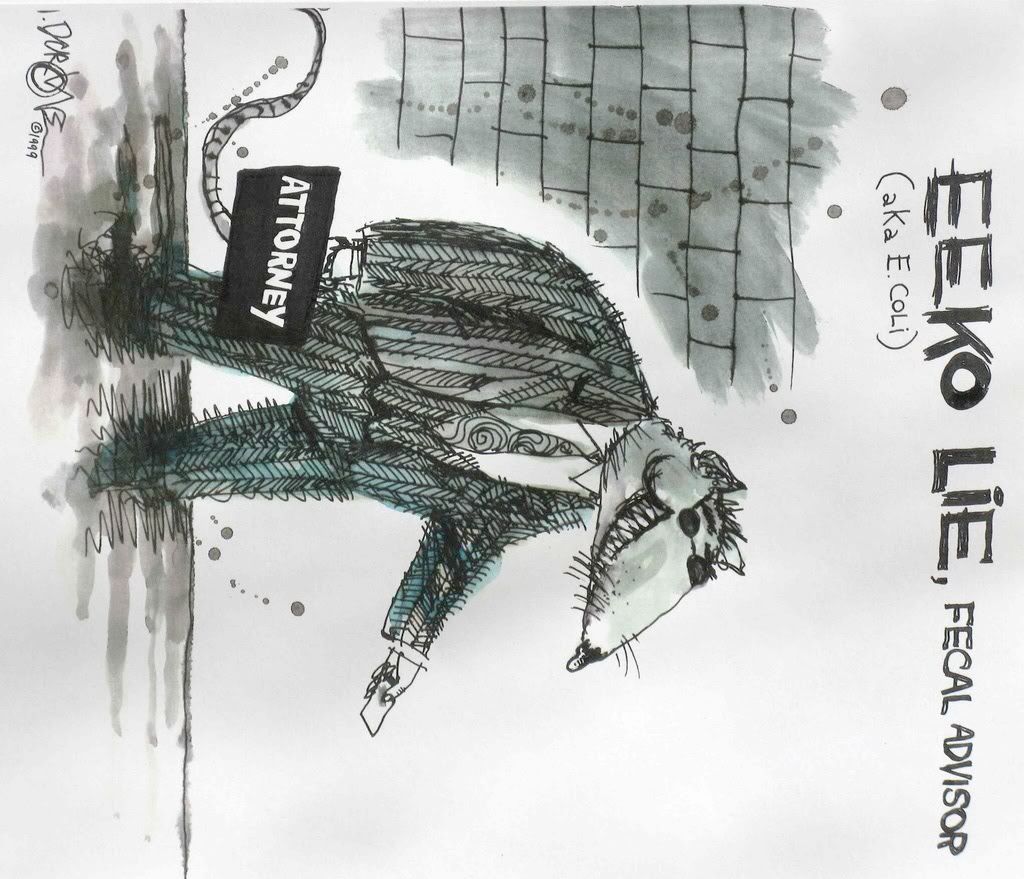

The House Subcommittee on Oversight and Investigations heard today from two of the more than 1600 victims of the Salmonella Enteritis outbreak, both of the companies whose eggs were linked to that outbreak, and the Principal Deputy Commissioner of the FDA. The Subcommittee chose not to hear from USDA, whose Agriculture Marketing Service is responsible for egg-grading activities at both company's operations.

Sarah Lewis (Freedom, CA) and her sister were two of the earliest recorded victims of the outbreak. They both became ill last May, after eating a custard tart served during Sarah's sister's college graduation banquet. Sarah was hospitalized twice – including three days in a coronary critical care unit – and developed colitis as a result of a secondary Clostridium difficile infection. Sarah remains a carrier of Salmonella Enteritis and continues to suffer aftereffects of her illness.

Carol Lobato (Littleton, CO) is 77 years old. On July 10th, Carol and her husband Ed took their grandson Drew to dinner at The Fort Restaurant in Morrison, Colorado. All three shared an appetizer of rattlesnake cakes. Carol, who suffers from rheumatoid arthritis and takes immunosuppressive medications, developed septic shock and was admitted to hospital. Ed and Drew also were ill, but not as severely as Carol, who remained in hospital for five days. Salmonella Enteritidis – an exact DNA match to the strain recovered at Wright County Egg – was found both in Carol's bloodstream and in her intestines.

Sarah Lewis and Carol Lobato suffered life-threatening illnesses through no fault of their own. All they did was to enjoy a celebratory meal with their families.

In the first two parts of this series, I proposed six steps that I believe would improve the ability of federal food safety agencies – mainly FDA and USDA – to carry out their responsibility to US consumers. Following are an additional four steps that can be taken to answer Carol Lobato's plea and improve the safety of the US food supply.

Step 7. Pass and implement mandatory recall authority for FDA and USDA
The Canadian Food Inspection Agency has mandatory recall authority. So does the UK Food Standards Agency. So does Food Standards Australia. So do the food regulators in a number of other countries.

In the United States, the Consumer Product Safety Commission has mandatory recall authority. USDA does not, but can "encourage" a recall by threatening to withdraw its inspector from a plant that it oversees. FDA has no such means of persuasion. Its only rapid response recourse in the absence of a company's cooperation is to issue a Health Alert – as it did earlier this year to warn pet owners about dog treats that were at risk of being contaminated with Salmonella.

In fact, Canada, the UK and Australia rarely have to invoke their recall authority. The mere existence of this provision is enough to ensure cooperation on the part of the food manufacturer, processor or distributor whose product safety has been called into question.


Step 8. Pass and implement traceability for all food products
One of the most problematic parts of a food outbreak investigation is tracing the origin and distribution of a suspect food. Unless companies are required to maintain complete and detailed records – and make those records available to regulators in the event of a product contamination issue – a contaminated food cannot be tracked back to its source or forward to its destination. Without effective traceability, contaminated food inevitably will remain on the market and in the hands of consumers.


Step 9. Increase FDA's budget for routine inspections of domestic food processors
According to FDA's Principal Deputy Commissioner, Dr. Joshua Sharfstein, who testified at the Egg hearing, the agency has the wherewithal to carry out approximately 18,000 inspections annually. That sounds like a lot of inspections, except that there are 150,000 facilities in the US under FDA jurisdiction. FDA simply must be given the money to do its job, if we are to see any significant reduction in the number of foodborne outbreaks in the United States.


Step 10. Introduce steep, mandatory penalties – including prison sentences – for egregious or repeat offenders of food safety laws
Malefactors such as Peanut Corporation of America's Stewart Parnell or Wright County's DeCoster should not be able to extricate themselves with a formal apology and a slap on the wrist.


My Ten Steps are not the entire answer to the problems that beset the food safety system in the United States. They are just the first steps in a long journey back to a food system that US consumers can depend upon and that members of the food industry can be proud of.


If you would like to receive automatic email alerts for all new articles posted on eFoodAlert, please click here or submit your request using the sidebar link. Please include "subscribe eFoodAlert" in the subject line.

Ten Steps To A Safer Food Supply: Part Two

"There is no more basic role for government than ensuring safe food..."


The Food Safety Modernization Act (S. 510) is not quite ready to be embalmed, according to Alicia Mundy of the Wall Street Journal, but it is definitely on life-support.

The bill faces opposition from Senator Tom Coburn, who wants to know how the Administration plans to cover the estimated $1.4 billion dollar cost of improving the country's food safety system. Small farmers are worried about paying for the improved sanitation standards and product tracing requirements contained in the legislation. And California Democratic Senator Dianne Feinstein wants to add a provision to ban bisphenol A in food packaging.

All in all, not a promising situation.

In Part One of this series, I proposed three steps towards putting food safety on a sounder footing in the United States. Here are some additional ideas:

Step 4. "Routine" does not make it right
USDA egg graders working at Wright County Egg wrote daily sanitation reports on conditions at the farm, but didn't notify FDA of the unsanitary conditions because "the conditions at the egg plant packing facilities were routine," according to a Wall Street Journal report.

Inspectors and graders working at USDA and FDA must be trained to view with alarm any conditions – "routine" or not – that put the health of the consumer at risk. These individuals must also be assured by senior management at both agencies that anyone who blows the whistle on deviations from food safety laws and regulations will be protected from reprisals.


Step 5. Implement existing food safety laws that have been languishing on the shelf
Congress passed an updated Sanitary Food Transportation Act in 2005, instructing the Secretary of Health and Human Services to ". . . issue regulations setting forth sanitary transportation practices . . . in food transport." On April 30, 2010, FDA finally published an Advance notice of proposed rulemaking to solicit data and information from the food transportation industry. That's five years of inaction – five years of unnecessarily exposing the country's food supply to possible insanitary or improper transportation and storage conditions.

There is simply no excuse for procrastination. Federal agencies must promptly begin the process of implementing food safety legislation as soon as it has been signed into law.


Step 6. Interpret existing food safety laws with a bias in favor of food safety
The Federal Food, Drug, and Cosmetic Act states that a food is adulterated if (among other things):
  • it bears or contains any poisonous or deleterious substance which may render it injurious to health;
  • it consists in whole or in part of any filthy, putrid, or decomposed substance; or
  • it has been prepared, packed, or held under insanitary conditions whereby it may have become contaminated with filth, or whereby it may have been rendered injurious to health.
The Federal Meat Inspection Act defines carcasses, parts of carcasses, meat, or meat food products as adulterated if (among other things):
  • it bears or contains any poisonous or deleterious substance which may render it injurious to health;
  • it consists in whole or in part of any filthy, putrid, or decomposed substance or is for any other reason unsound, unhealthful, unwholesome, or otherwise unfit for human food; or
  • it has been prepared, packed, or held under insanitary conditions whereby it may have become contaminated with filth, or whereby it may have been rendered injurious to health.

FDA and USDA have the authority under these existing laws to act decisively when confronting contaminated food. To dither over which pathogens should be considered adulterants and which ones should be winked at is to shortchange the people that these agencies are in business to serve. What part of "injurious to health" do these agencies – most notably, USDA – not understand?


Please watch for Part Three of this series, where we'll continue our walk down the road to safer food.


If you would like to receive automatic email alerts for all new articles posted on eFoodAlert, please click here or submit your request using the sidebar link. Please include "subscribe eFoodAlert" in the subject line.

Tuesday, September 21, 2010

Ten Steps To A Safer Food Supply: Part One

"Protecting the safety of our food and drugs is one of the most fundamental responsibilities government has, and . . . it is a responsibility that I intend to uphold in the months and years to come."


Eighteen months after President Obama made this commitment, Senate Majority Leader Harry Reid announced the death of the Food Safety Modernization Act (S. 510).

S.510 incubated in the Senate for more than a year, taking a back seat to health care reform, financial system reform, and stimulus packages. While it languished, the US food industry logged 85 safety recalls – most of them due to contamination by Salmonella and Listeria monocytogenes. Nine of the recalls were linked to 1,850 reported illnesses (data supplied by the U.S. Public Interest Research Group, the Center for Science in the Public Interest and the consumer Federation of America).

The time for wringing our collective hands over the sorry state of the US food safety system is past. It is time to act. Here's what I propose:

Step 1. Establish an on-line clearing house where consumers can report food safety problems
Consumers are the first to suffer the consequences of unsafe food. When an individual has a problem with a food, he or she should not have to figure out who has jurisdiction over that specific item. We need a single on-line consumer complaint portal. Any consumer should be able to access and complete a fill-in form detailing the food safety issue, and be confident that the complaint will be directed automatically to the appropriate federal, state or local agency for follow-up.

The portal also will serve as a means of tracking trends in food safety complaints, and help FDA and USDA to evaluate high risk foods and food processors for priority investigation. In addition, consumers would be able to flag instances of recalled foods that remain on store shelves in their areas.

The complaint portal must be widely publicized. Any organization with an interest in food safety – news outlets, consumer groups, state and local governments – would be encouraged to maintain a live link to the complaint portal on their web sites.


Step 2. Initiate full disclosure of retail distribution for all Class 1 (high risk) food recalls.
Last month, California – a state deeply mired in debt – published a list of all retailers, restaurants, nursing facilities and food service operations that were supplied with recalled eggs. The list, which was last updated September 14th, is 198 pages long. USDA's Food Safety and Inspection Service publishes a distribution list for all Class 1 recalls, but excludes restaurants, food service operations and other facilities that serve food rather than sell retail packages. FDA does nothing to tell consumers where recalled food was sold, except for providing a list of states.

FDA and USDA should immediately implement a full retail distribution disclosure policy for all Class 1 recalls. This does not require any new legislation. There is no valid excuse to withhold this information from the public.

In addition to full public disclosure, FDA and USDA should seek the authority to require that public recall notices be posted by any retailer, restaurateur or food service operator who was supplied with a recalled product. The notices should be posted prominently adjacent to the shelf or refrigerated/freezer case where the product had been displayed (in a store or cafeteria), and also posted at the entrance to each establishment.


Step 3. Disclose the contents of all food facility inspection reports
FDA discloses the contents of its "483" food facility inspection reports when the agency judges that there is sufficient interest to warrant the disclosure. Other reports only are released in response to a Freedom of Information Act request. Such requests must be made in writing (no email requests allowed), may take months to process, and must be paid for by the individual or organization that makes the request. USDA does not release any inspection reports, except in response to Freedom of Information Act requests.

FDA and USDA should both implement full disclosure of all inspection reports (redacted to remove commercial proprietary information, as FDA now does). The public has the right – and the need – to know which companies are doing their best to produce safe food, and which ones are just scraping by.


Please watch for Part Two of this series, where we'll take a few more steps down the road to safer food.


If you would like to receive automatic email alerts for all new articles posted on eFoodAlert, please click here or submit your request using the sidebar link. Please include "subscribe eFoodAlert" in the subject line.
