Showing posts with label SF2009. Show all posts

Saturday, November 7, 2009

A Multitude Of Mushrooms

November 7, 2009

Many years ago, when I was an undergraduate microbiology student at McGill University in Montreal (Canada), I took a mycology course given by the Botany Department. Unlike courses in clinical mycology that I have taken, the Botany Department course surveyed fungi that live and grow in fields and forests.

The professor marked our final lab session by preparing for us a dish of mushrooms sautéed with butter and sherry. Needless to say, we gave him an "A+" for his final grade.

Despite – or perhaps because of – having taken that course, I have never tried to pick wild mushrooms for the dinner table. There are too many poisonous varieties that resemble completely innocuous mushrooms.


Everyone is familiar with the typical cultivated mushrooms that are found, either loose or packaged, in the produce section of the local supermarket. These mushrooms were on display at the San Francisco Farmer's Market in September.


They can easily be confused with two very poisonous mushroom varieties – Amanita phalloides and Amanita ocreata – that, between them, were responsible for 894 episodes of poisoning in the state of California in 2008.

As I was reminded while roaming the Farmer's Market, edible mushrooms come in a surprising range of shapes, sizes and colors. There are chanterelles and cioppini, portobello and pioppini, lobster mushrooms and oyster mushrooms.


These are just some of the mushroom varieties that were on display at the market.


And here are a few more.


The lobster mushrooms and oyster mushrooms intrigued me most – not only due to their names, but because of their growth and development.

Oyster mushrooms come in a variety of sizes and colors. They grow wild on dead tree bark, and look for all the world like oyster clusters. They are also reputed to taste like oysters.


A lobster mushroom is the result of a parasitic fungus growing on certain species of mushrooms. The parasite changes the color, shape and texture of its host mushroom, producing a lobster mushroom.


With the amazing variety of mushrooms that are available at Farmer's Markets such as the one in San Francisco, who needs to forage for fungi in the field?

Monday, October 12, 2009

Say Raw Milk Cheese, Please!

October 12, 2009

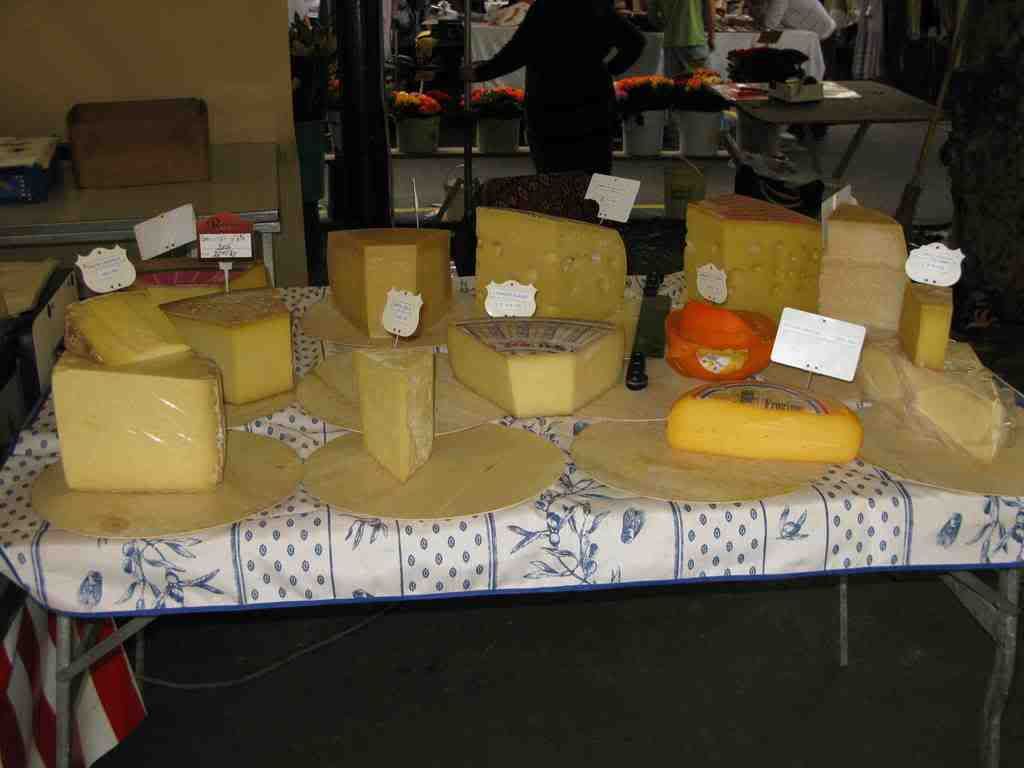
To visit France is to experience cheese in its infinite variety of aromas, flavors and textures.

The French take their cheese seriously, and frown on the North American practice of using pasteurized milk to make cheese. Indeed, European cheeses that wish to boast a "Protected Denomination of Origin" – the cheese equivalent of wine's "Appellation d'Origine Contrôlée" – must be manufactured from raw milk.

The US Food and Drug Administration permits the manufacture and marketing of hard cheese made from raw milk, if the cheese is aged at a temperature of at least 35ºF for no less than 60 days. Blue, brick and cheddar are a few of the cheeses that fall into this category.

Point Reyes Farmstead Cheese Company was just one of the raw milk-blue cheese producers on display at the San Francisco Farmer's Market during our visit last month. The company makes its cheese exclusively with milk from its own herd of Holsteins. The cheese-making process begins within a few hours after milking, and the cheese is allowed to age for six months – well beyond the 60 days required by FDA.


"But," you ask, "What about Listeria monocytogenes, Salmonella and E. coli? Is raw milk cheese as safe to eat as cheese made from pasteurized milk?"

According to Dr. Catherine W. Donnelly, University of Vermont Professor, Listeria monocytogenes expert, and co-Director of The Vermont Institute for Artisan Cheese ("VIAC"), the answer is "Yes" – as long as cheesemakers are educated about how to ensure the safety of their raw-milk products.

VIAC offers Beginning and Advanced Cheesemaking Certificate programs, which include a course on Hygiene and Food Safety In Cheesemaking, and one on Risk Reduction Practices. The Institute also conducts ongoing research, including programs on Cheese Microbiology and Safety and Milk Quality.

Vermont and California are not the only states taking a hard look at hard cheeses made with raw milk. Maryland recently introduced a pilot program to encourage the production of raw milk cheeses on a few farms in the state. Pennsylvania, too, encourages an artisan cheese industry.

But don't expect FDA to expand its acceptance of raw milk cheeses beyond the hard cheese varieties. Recent research carried out by Dr. Donnelly and her University of Vermont colleagues showed that Listeria monocytogenes can grow on aged soft cheeses (e.g., Brie and Camembert). This is true regardless of whether the cheeses were made using pasteurized milk or raw milk.

Sticking to pasteurized milk for the production of soft cheeses reduces the risk of pathogens in the raw ingredients and, therefore, in the finished cheeses. Nevertheless, Listeria monocytogenes, which is found just about everywhere in the environment, can contaminate the cheese after it is made.

What does this mean for the consumer? Simply, anyone who is elderly, very young, pregnant, or suffers from a weakened immune system for any reason, should avoid eating soft cheeses – especially those made from raw milk. Hard cheeses that were made from fresh milk of high microbiological quality and held at 35ºF for 60 days or more, are far less likely than soft cheeses to support growth of bacterial pathogens.

The insertion of sound science into the cheesemaking process by organizations such as VIAC is good for both the dairy industry and the consumer. If we continue along this path, the United States will someday be able to rival its European cousins in the art and science of artisan cheesemaking. As you can see, we're already not doing too badly.


Some of the information contained in this article came from the following source:

D’Amico, D.J., M.J. Druart, and C.W. Donnelly. "60-Day Aging Requirement Does Not Ensure Safety of Surface-Mold-Ripened Soft Cheeses Manufactured from Raw or Pasteurized Milk When Listeria monocytogenes Is Introduced as a Postprocessing Contaminant" in Journal of Food Protection, vol 71(8): 1563–1571. 2008.

Thursday, October 8, 2009

Restaurant Inspections: Does Publishing The Results Do Any Good?

October 8, 2009

On our recent trip to San Francisco, my husband and I stayed at the Union Street Inn, a Bed and Breakfast located in the Cow Hollow district. We chose the Inn based on its excellent reviews on TripAdvisor.com.

When we presented ourselves at breakfast the morning after we arrived, I was delighted to see that the Inn had achieved a score of 100% on its most recent food service inspection. But – even though I am a food safety microbiologist – it hadn't occurred to me to look into the food inspection history of the Inn before we made our reservation.

Most cities and counties in the developed countries carry out some form of routine restaurant inspection. Many local health departments post these inspection results on their web sites. Some jurisdictions – San Diego, Los Angeles and many counties in the United Kingdom, for example – go farther, and require that restaurants post their most recent inspection score on or near the front door (known as "Scores on Doors"). And a few agencies – including New South Wales, Australia – take the "Name and Shame" approach, publishing the names of food establishments that fail inspection.

Surprisingly, San Francisco does not require its restaurants to post their inspection scores. Instead, consumers must visit the web site of the San Francisco Department of Public Health to learn how their favorite restaurants stack up.


We stopped in at The Real Food Company, a local market and deli, for a snack one day.


I was favorably impressed with the care taken by a store employee in handling raw poultry as he loaded it into the rotisserie.


According to the San Francisco Department of Public Health, the store was inspected on September 3rd, just a few days before our visit. Real Food received an "A" rating, with a score of 90 points (out of 100). A score of 89 points would have meant a "B" rating. The inspector noted three violations – two "moderate risk" and one "low risk."

There has been a lot of on-line discussion recently on various food safety blogs about restaurant sanitation, "Scores on Doors" programs, and other food service issues. BarfBlog, in the United States and Le Blog d'Albert Amgar in France are both regular and responsible contributors to this topic.

I wonder, though, how many people take notice of restaurant inspection reports? Does anybody care?


It's time for an eFoodAlert survey

Question #1: Is there a "Scores on Doors" program where you live? If so, have you ever decided not to eat at a restaurant because of a low inspection score (less than an "A")?
Question #2: Have you ever checked a restaurant's inspection score on-line either before or after eating there?
Question #3: Have you or a family member ever become ill after eating a meal at a restaurant? If so, please describe the circumstances.
Question #4: What – if anything – do you think your local health department should do to make the public aware of restaurant inspection results?


I want to hear from you. Please either post your comments below or email them to me (click on my Profile to find my email address). I'll consolidate and post your replies in a follow-up to this article.


Tuesday, October 6, 2009

Free-Range, Organic, Air-chilled Poultry: Does Salmonella Care?

October 6, 2009

One of the stops we made at the San Francisco Farmer's Market last month was Aimee's Mountain Ranch Kitchen, where we learned the following about the Certified Organic poultry on display.


Last Thanksgiving, my husband and I opted for a locally raised free-range turkey in place of the our usual supermarket bird. I have to report that, while the local bird was tasty, it also was one of the toughest, boniest turkeys we had ever roasted. I guess you have to be tough to thrive in Vermont!

Although Aimee's Mountain Ranch Kitchen does not claim that its Certified Organic, free-range, air-chilled chickens are microbiologically safer than conventional birds, some people believe that poultry raised and processed under these conditions is less likely to contain pathogens, notably, Salmonella and Campylobacter. Unfortunately, this is not so.

In 2005, researchers at the University of Maryland found that 76% of organic chickens and 74% of conventionally raised chickens available in retail stores contained Campylobacter. Salmonella was found in 61% of the organically raised chickens and 44% of the conventional birds. Similarly, in a University of Louisiana study, Salmonella was recovered from 22% of conventional chicken carcasses in the Baton Rouge area and from 21% of organically raised chicken carcasses.

What about free-range vs. cage-reared birds? Don't count on seeing any microbiological benefit here, either. Studies in the United States and Great Britain have shown that free-range birds are just as contaminated as cage-reared poultry.

Then, is chilling poultry carcasses in air any safer than by immersing them in cold water? Air-chilling sounds as though it would be less likely to foster the transfer of Salmonella and Campylobacter from a few contaminated birds to an entire batch of "clean" carcasses. But research studies published in 2003 and 2007 failed to substantiate this.

Nevertheless, there are some benefits to free-range, organic farming and air-chilling of poultry carcasses.
  • Water-chilling often results in 8-12% water (by weight) being retained by a carcass, according to USDA. This "retained water" must be declared on the label. Air-chilling eliminates the extraneous water that otherwise is added to poultry carcasses – water that the consumer pays for, since poultry is sold by weight.
  • While conventional and organically raised poultry don't differ significantly in their level of Salmonella contamination, the University of Louisiana study (mentioned above) found that Salmonella recovered from conventionally raised birds was far more likely to be antibiotic-resistant.
  • Air-chilling reduces the amount of water used by poultry processors – a serious concern in drought-prone areas.

Because free-range and organic farming are more labor-intensive than conventional large-scale industrial farming, organic and free-range chicken tends to be more expensive. Whether the outcome of these artisan farming procedures is worth the added cost is a judgment that each consumer has to make.

Whether you decide to buy a conventionally raised chicken or a free-range, organic bird, remember to handle the carcass as though it contains Salmonella and Campylobacter.
  • Cook the chicken to an internal temperature of 165ºF, using a meat thermometer to verify the temperature;
  • Clean and disinfect all kitchen implements, cutting boards and counter tops that may have come into contact with the raw chicken;
  • Wash your hands thoroughly after handling raw chicken; and
  • Sanitize wet sponges and dishrags by microwaving them on the highest setting for at least 30 seconds.

Sunday, October 4, 2009

San Francisco's Other Chocolate Company

October 4, 2009

Located inside the Ferry Terminal building on the San Francisco Embarcadero is Artisan Confections, the retail home of San Francisco's best kept chocolate secret – Scharffen Berger Chocolate Maker.

The company was founded in 1997 by Robert Steinberg and John Scharffenberger, with the aim of producing full-flavored dark chocolate using traditional methods, while controlling the process "from bean to bar."

Scharffen Berger sources its own beans, working with cacao farmers in South American, Africa and Asia. While the company occasionally produces chocolate from a single source – at present, offering single origin chocolate from Ghana and from Vietnam – most chocolate is a blend of beans from different regions. The origin of the beans, together with the fermentation conditions and adjustments to the blend all contribute to the final flavor and texture of the finished chocolate.

Here is how Andrew McIntyre of Artisan Confections explained the difference between single origin and blended chocolate.


"You can deprive the body, but the soul needs chocolate."

Wednesday, September 30, 2009

Probiotic Pickles

September 30, 2009

Probiotic: A microbe that protects its host and prevents disease. (www.medterms.com)


It doesn't take much more than a stroll down the supermarket dairy case aisle to realize that probiotics are hot. A quick glance at the yogurt display reveals competing claims by two major international dairy brands, Dannon (Danone in France) and Yoplait.

Nor is the marketing of probiotic foods limited to the dairy industry. Even sour pickles are getting into the act, as we discovered during our recent stroll through the San Francisco Farmer's Market.

The Happy Girl Kitchen Co. is a Central California packing company that specializes in preserving and packing local organic produce. The company sells its wares over the Internet as well as at Farmer's Markets in Santa Cruz and in the San Francisco Bay area.

While the Company's web site makes no probiotic claims for its dill pickles – or any other of its fermented products – the Happy Girl who we met at the Farmer's Market told us the following:


Happy Girl is not alone in claiming health benefits for fermented dill pickles and other fermented non-dairy foods, such as sauerkraut and various ethnic pickled vegetables. A quick Google search turns up numerous blogs, web sites and other articles on the subject.

While some of the claims may be exaggerated, the fundamental principles are sound. Yogurts, other fermented dairy products (e.g., cheeses, buttermilk and kefir), pickles and sauerkraut result from the growth of lactic acid-producing bacteria – notably Lactobacillus. The benefits of consuming foods that have been fermented by lactic acid bacteria are several:

  • Lactic acid is a natural preservative
  • While growing, Lactobacillus produces compounds (known as prebiotics) that encourage the development of helpful bacteria in the intestinal tract
  • Many Lactobacillus bacteria produce natural anti-microbial compounds (known as bacteriocins) that act against pathogens such as Listeria monocytogenes
  • The presence in the intestines of probiotic bacteria – including many Lactobacillus bacteria – aids digestion and helps lactose-intolerant individuals to digest dairy-based products

Unfortunately, not all Lactobacillus are created equal. Not all strains produce effective bacteriocins. And some strains are better able than others to survive the harsh acid environment of the stomach and take up residence in the intestines. In a completely natural fermentation, there is no way to predict which strains of lactic acid bacteria will take charge.

Despite these caveats, the health benefits of prebiotics and probiotics are well established, and the role of Lactobacillus strains and other lactic acid bacteria in aiding digestion has been recognized for many years. And whether or not a particular batch of pickles contains a strongly probiotic Lactobacillus strain, it still can be counted on for some prebiotic benefits.

Happy Girl's customers can keep on smiling.

Saturday, September 26, 2009

Bruschetta: It's What's For Lunch

September 27, 2009

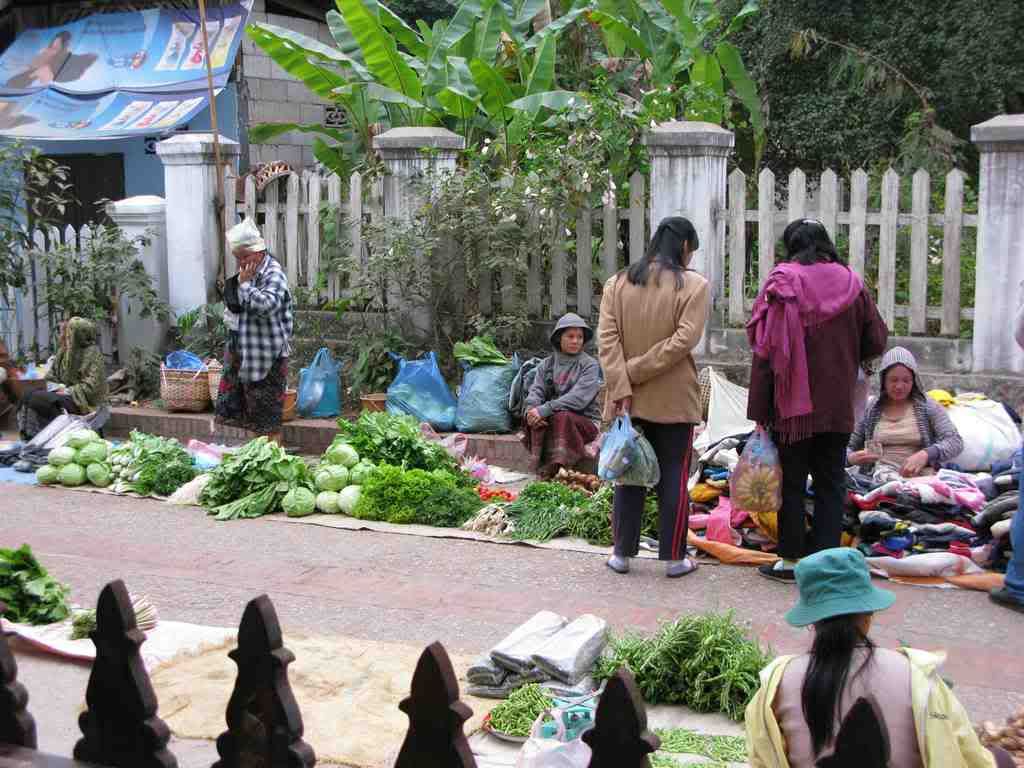
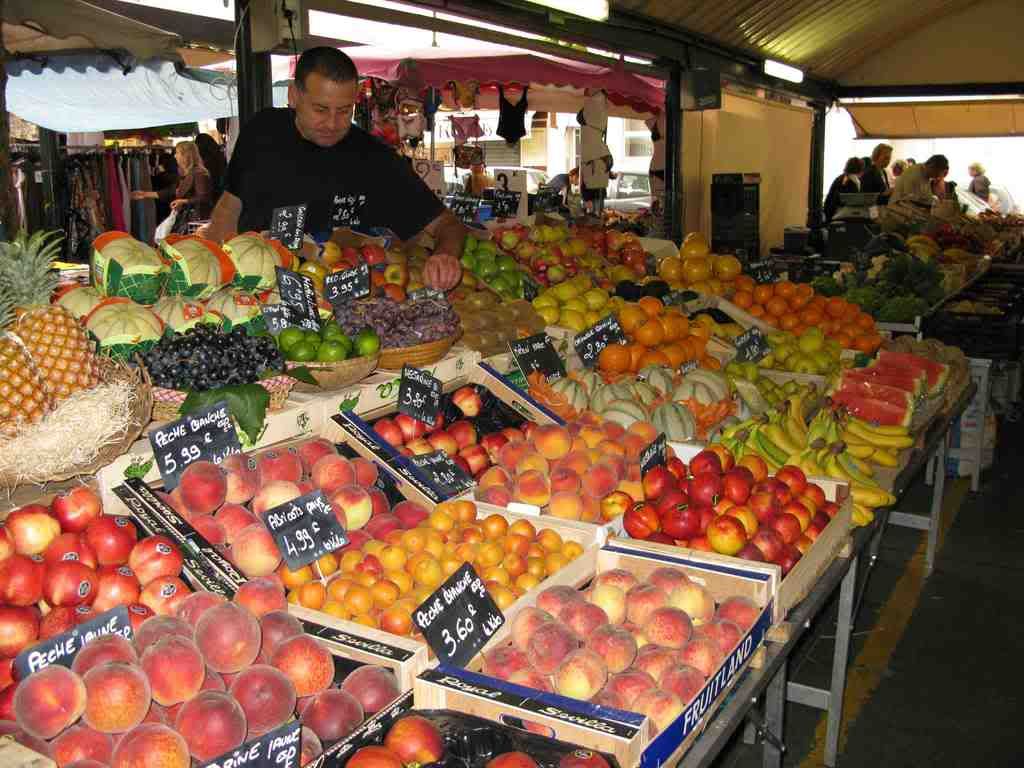
One of the joys of travel – for me, anyway – is visiting local food markets and farmer's markets. Whether in SouthEast Asia or the south of France, these markets are a reflection of local culture and cuisine.


A street market in Luang Prabang, Laos


A fruit stall in Cannes, on the French Riviera


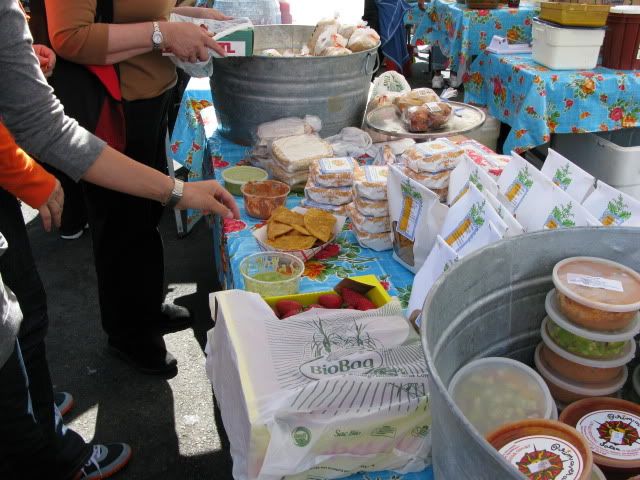
One of the most impressive farmer's markets I have seen is held every Tuesday and Saturday in and around the San Francisco Ferry Terminal building at the foot of Market Street. A determined grazer can enter the market hungry and emerge replete, having experienced a savory blend of fruits, preserves, salsas, cheeses and baked goods.


Samples of goat cheeses – free for the asking


A variety of salsas and dips on offer to passers-by


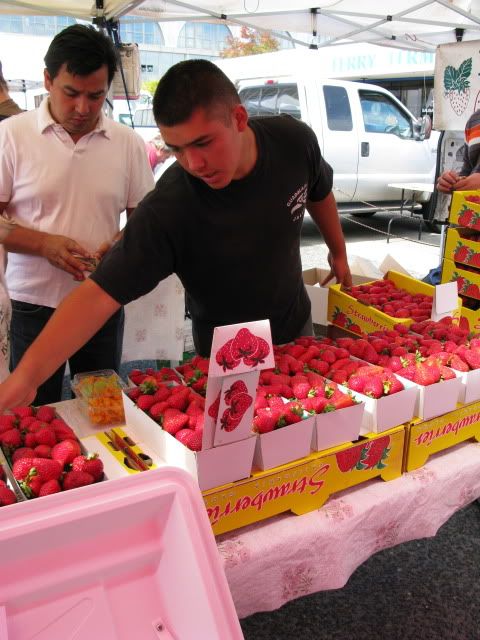
The ripe strawberries were very tempting


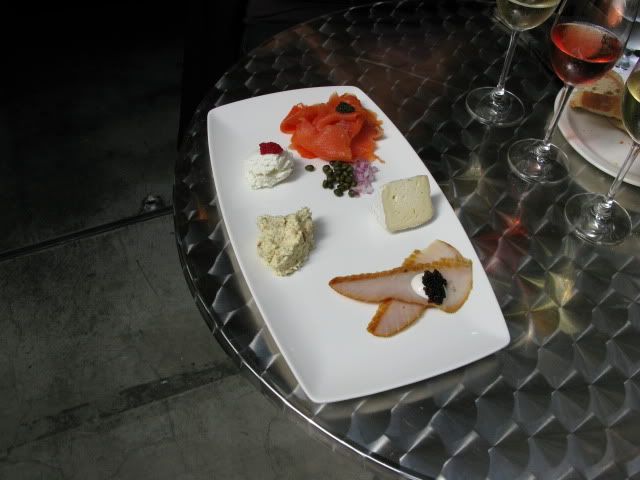
A more sophisticated grazer could opt for champagne and caviar


The Bruschetta stand was especially popular around noon. The open-faced Tuscan-style sandwiches were heaped with fresh tomatoes, sliced onions, capers and crumbled cheese.


The Bruschetta stand's operator was well organized


I'll be offering more video visits to the San Francisco Farmer's Market in upcoming posts.

Thursday, September 24, 2009

Life's Sweet Mysteries

September 24, 2009

I've been on a "busman's holiday" for most of this month, chasing down – with the assistance of my intrepid photographer – the answers to some of life's mysteries.

I thought of beginning my quest by delving into the metaphysics of how Cadbury gets the caramel into its Caramilk bar. But that's already been done.

Next, I considered investigating how the trademark "m" is placed so consistently in the center of each M&M candy. But someone else beat me to it.

So I decided to focus on that other sweet mystery, namely:

"How do they get the fortune into the fortune cookie?"


The investigation took us westward to an exotic destination.


Sorry – overshot the destination. I think we're on the right track now.


Ah, yes. Chinatown!


Around the corner and down a back lane, we found the solution to our mystery – the tiny Golden Gate Fortune Cookie Factory, which has been a San Francisco fixture for many decades.


Please play the video to see how fortune cookies are made.


I'll be reporting on more sweet (and sour) mysteries in future posts.