Thursday, July 17, 2008

Food Poisoning: Names Behind The Numbers

CDC published its daily update on the Salmonella Saintpaul outbreak yesterday evening. As of 9pm (EDT) July 15th, the agency has received reports of 1,196 lab-confirmed victims of this outbreak. Two hundred twenty-four people have been hospitalized.

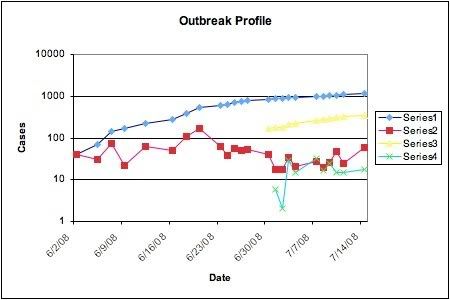
At least 372 of the victims began to experience symptoms of salmonellosis on or after June 1st – up from 357, the day before. After a very brief drop into single digits, the day-over-day increase in relatively recent cases is back into the teens.

eFoodAlert Outbreak Profile As Of July 16th CDC Report


Statistics can give some insight into the scope and duration of a disease outbreak. When the numbers are massaged appropriately, they can even give direction to investigators who are searching for the source of the outbreak.

But behind each number is a name, and behind each name is a victim. While we continue to monitor the "progress" of this current outbreak of salmonellosis, let's also remember a few of the many victims of food-borne disease.
  • Alexander Thomas Donley (January 28, 1987-July 18, 1993).
    Victim of E. coli O157:H7 (Jack In The Box outbreak)
  • Kevin Kowalcyk (died August 11, 2001; 2 years, 8 months, 1 day old).
    Victim of E. coli O157:H7 (sporadic case)
  • Luz Romero (died in 1985 at age 83).
    Victim of Listeria monocytogenes (Jalisco cheese outbreak)
  • Thomas Levins (died in 1985 at age 44).
    Victim of Salmonella (Jewel Dairy outbreak)
  • Raul Rivera (died in 2008 at age 67).
    Cancer patient infected with Salmonella Saintpaul.
And yesterday evening Bill Marler gave a voice to some of the victims of the Nebraska Beef E. coli O157:H7 outbreak, when he wrote,
No surprise to the folks sitting in the ICU waiting room of the Archbold Hospital in Thomasville, Georgia who I met with today. Three women in ICU with families at their side – life should not hang in the balance at age 70 after going to a local restaurant you have visited for years. A teenager should not be at risk of kidney failure after eating a burger. An adult man should not loose weeks of works for eating out.
Let's never lose sight of the names behind the numbers.

Wednesday, July 16, 2008

CDC Acknowledges Georgia Affected by Nebraska Beef Outbreak

CDC finally got the word. In its E. coli O157:H7 outbreak update, released late this afternoon, the agency added Georgia to the list of states affected by the outbreak linked to beef and beef trimmings supplied by Nebraska Beef. That company recently recalled approximately 5.3 million pounds of beef in response to the outbreak.

The tally of victims, according to CDC, now stands at 45 people in six states: Georgia (1), Indiana (1), Kentucky (1), Michigan (20), New York (1), and Ohio (21). Twenty-three people have been hospitalized – one with hemolytic uremic syndrome.

But there are some discrepancies between the CDC report and information that has been released by Michigan and by the Southwest Georgia Public Health District 8-2.

CDC recognizes only 20 lab-confirmed cases in Michigan. As long as a week ago (July 9th), the Michigan Department of Community Health reported 22 lab-confirmed cases, of which 12 were hospitalized.

Even more glaring is the difference between CDC and county data in the Georgia outbreak cluster. CDC has acknowledged just one case from Georgia, whereas the Public Health District has reported 8 confirmed cases and 4 probable cases.

All of the Georgia cases are linked to the Barbecue Pit restaurant, which purchased meat – through a distributor – that originated with Nebraska Beef. A sample of ground beef obtained from the restaurant was found to be contaminated with the outbreak strain of E. coli O157:H7.

How many more states have experienced either sporadic cases – or clusters – of E. coli O157:H7 illness that are part of this same outbreak?

Hepatitis Warning in Burlington, Iowa

The Iowa Department of Public Health posted a warning to patrons of Whitey's Bar and Billiards in Burlington, IA after a food service employee of Whitey's was diagnosed with hepatitis A. The warning extends to all Whitey's customers who visited the restaurant between June 25th and July 13th, and who consumed any salad bar items or any drinks that contained ice or lemon slices.

Whitey's patrons who consumed any of these items between the dates of July 2 through and including July 13 should arrange to receive either Hepatitis A vaccine or immune globulin immediately. It is too late for those exposed before July 2 to obtain any benefit from an injection.

According to the state's news release, the Des Moines County Health Department will hold a walk-in clinic to administer Hepatitis A vaccine at the following location and times:

Des Moines County Health Department
522 North 3rd Street
Burlington, Iowa

  • Wednesday, July 16 - 9 a.m. to 8 p.m.
  • Thursday, July 17 - 9 a.m. to 8 p.m.
  • Friday, July 18 - 9 a.m. to 6:30 p.m.
The vaccine and immune globulin injections are not 100% protective. Therefore, all of those who were potentially exposed to the infected food service worker – whether or not they receive a protective dose of vaccine or immune globulin – should be watchful for symptoms of hepatitis A, and also should be especially careful of their personal hygiene.

While infrequent, restaurant-associated warnings and outbreaks of hepatitis A pop up from time to time. This year has seen several, including:
Whenever there is a significant outbreak of restaurant-associated hepatitis A – or a warning that involves a large number of restaurant patrons – the question of mandatory vaccination for food service workers is raised. Now, only two counties in the United States have this requirement on their books – St. Louis County, Missouri and Clark County, Nevada.

From an economic perspective, mandatory vaccination does not appear to make sense. A 2001 study carried out by CDC concluded that,
"Vaccinating restaurant employees is unlikely to be economical from either the restaurant owner or the societal perspective, even during hepatitis A epidemics."
As I reported in an earlier hepatitis post, roughly one-third of the US population already carries immunity to Hepatitis A virus, and CDC recommends that all children be vaccinated against Hepatitis A before their first birthday.

Economics isn't everything, though there's no point in mandating that someone who is already immune to the virus be vaccinated as a condition of employment.

But why not require all food service workers to demonstrate either proof of immunity to Hepatitis A or proof of vaccination before they are permitted to handle food or come into contact with restaurant patrons?

Tuesday, July 15, 2008

Salmonella Saintpaul Outbreak: Running Out Of Steam?

It's premature to draw any conclusions, but there's just a glimmering of hope that the Salmonella Saintpaul outbreak is starting to run out of steam.

CDC has just updated its statistics on this very frustrating outbreak. As of 9pm EDT yesterday, the agency has received reports of 1,167 lab-confirmed cases of salmonellosis caused by the outbreak strain. At least 220 of the victims required hospitalization.

Of the 1,167 cases, at least 357 individuals began to experience symptoms on or after June 1st. This is an increase of only 9 people over yesterday's report - the first single-digit increase since July 2nd.


Today's Outbreak Profile


If this outbreak truly is winding down, we have the perishable nature of produce to thank. There has been no further news from FDA on the progress of their broadened investigation into possible sources of the outbreak strain.

E. coli O157:H7 - Moultrie (Georgia) Still On My Mind

I know that bureaucratic millstones grind slowly, but this is getting ridiculous.

CDC has – at last – posted an update on what began as the Ohio/Michigan E. coli O157:H7 outbreak. CDC is reporting a total of 44 confirmed cases of E. coli O157:H7 in five states: Ohio, Michigan, Indiana, Kentucky and New York. Twenty-one of the victims needed hospitalization, including one patient who developed hemolytic uremic syndrome.

All of these cases are linked to beef and beef trimmings that have since been recalled by their producer – Nebraska Beef – and by The Kroger Company, through which much of the meat was sold as ground beef. According to USDA, none of the meat included in the recall is still available in stores; but consumers are advised to check their refrigerators and freezers and discard any ground that is included in the recall notices.

Someone, though, seems to have mislaid the state of Georgia. According to a communiqué released by the Southwest Georgia Public Health District 8-2, a cluster of 8 lab-confirmed and 4 probable E. coli O157:H7 cases in the Colquitt County have been linked by molecular fingerprinting to the Nebraska Beef outbreak.

All of the Georgia victims ate at the Barbecue Pit restaurant in Moultrie. USDA has confirmed the presence of the outbreak strain in a sample of ground beef obtained from the Barbecue Pit restaurant. The Barbecue Pit's management has confirmed that it purchased sirloin beef for grinding from a distributor that, in turn, purchased meat from Nebraska Beef.

Colquitt County, GA knows about this cluster – the local media carried regular updates on the story. USDA knows about this cluster – it confirmed the presence of the outbreak strain in the meat sample. Georgia's state laboratory knows about this cluster – it identified and fingerprinted the cultures obtained from the eight confirmed victims. So why doesn't CDC know about this cluster?

For the record, including the Georgia cluster, there are now 52 lab-confirmed cases of E. coli O157:H7 in six states: Ohio, Michigan, New York, Indiana, Kentucky and Georgia. Five of the victims – including four in Georgia – have developed hemolytic uremic syndrome.

USDA hasn't covered itself with glory either. According to WALB News in Albany (GA), the sirloin beef that was supplied to the Barbecue Pit "...shares the same dates as the beef in the Nebraska Beef recall, but the meat cut itself does not appear to be part of the recall." If this is so, why has USDA not insisted that Nebraska Beef expand its recall once again?

USDA announced last Friday that it will finally begin to release the names of retail stores that have received recalled meat and poultry products – "...generally within three to ten business days..." of issuing a recall notice. This new policy will take effect next month. Unfortunately, the agency will not release the names of restaurants, food service facilities or distribution centers who have been supplied with recalled meat and poultry items.

USDA's new policy is a small step in the right direction – putting additional information in the hands of consumers. But it will only be useful if the agency also can convince suppliers of contaminated products to recall them promptly.

I'm left wondering whether either USDA or CDC have the institutional mentality and dexterity to respond quickly and effectively to contain outbreaks of food-borne disease.

Recalled Sandwiches May Contain Plastic Pieces

USDA has advised consumers of a nation-wide recall of more than 199,000 pounds of prepared sandwiches issued by Nestlé Prepared Foods Company.

The "Lean Pockets Spinach Artichoke Chicken" sandwiches were recalled after the company received communications from consumers, who complained about pieces of plastic. Two injuries have been reported.

The recalled product can be identified as follows:
9-ounce boxes of "Lean Pockets Spinach Artichoke Chicken - 2 sandwiches." Printed on the side of each box is a "Best Before" date of "Nov 2009" followed by a package code beginning "8144 544616." Also printed on the side of the package is the establishment number "P7721A."
Consumers with questions about this recall, or who want to report a problem, can contact the Nestlé Consumer Services Center at (800) 350-5016.

Monday, July 14, 2008

Salmonella Saintpaul: July 14th Update From CDC

The Salmonella Saintpaul outbreak shows no signs of ending. According to today's report from CDC, the most recent victim became ill on July 4th - just 10 days ago.

CDC now acknowledges 1,148 lab-confirmed cases; 220 people have been hospitalized. Victims of the Salmonella outbreak have been reported in 42 states and the District of Columbia. In addition, four Canadians who traveled in the United States became ill with the outbreak strain shortly after returning home.

While many older cases continue to be reported, at least 348 of the 1,148 people became ill on or after June 1st. Since CDC still is not breaking down case numbers by onset date, I am continuing to chart the cases by report date. Here is today's Outbreak Profile chart:


As of today, there has been no further news from FDA on the progress of their lab and field investigations.

Salmonella Saintpaul: Updated Canadian Advisory

The Public Health Agency of Canada and the Canadian Food Inspection Agency issued a joint advisory to Canadian consumers on Friday about the current status of the US outbreak of Salmonella Saintpaul.

In addition to the almost 1,100 US residents of 42 states and the District of Columbia, the outbreak has affected four Canadians. According to Friday's news release, the two Albertans and two Ontario residents became ill after traveling in the United States.

The joint advisory reminded Canadians to be aware of the foods that are suspected of being the source of this massive outbreak of salmonellosis. US authorities have fingered jalapeño peppers, raw serrano peppers and certain varieties of raw tomatoes as the most likely suspects, but have not been able to isolated the outbreak strain from any sample of food tested so far.

Canadian consumers should feel relatively secure when shopping for produce at home. Canadian-grown produce has not been implicated in this outbreak.

Hong Kong Issues Consumer Alert On Smoked Salmon

Last week, Washington state smoked salmon producer Salmolux, Inc. recalled a single batch of its Nova Lox after the Florida Department of Agriculture and Consumer Services detected Listeria monocytogenes in a sample of the product.

The recalled product was sold in retail stores in Arizona, California, Nevada, Delaware, Florida, Georgia, Maryland, North Carolina, Pennsylvania, South Carolina, West Virginia, and Virginia – and in Hong Kong.

On Friday, the Hong Kong Centre for Food Safety warned people not to purchase or consume Wild Alaskan Smoked Salmon Nova Lox, Batch #01418. The agency also instructed retailers to remove the product from store shelves.

Listeria monocytogenes can produced serious – sometimes fatal – illness in susceptible individuals. The very young, the elderly, people with compromised immune systems, and pregnant women are especially at risk of complications from an infection with Listeria monocytogenes.

Customers who purchased the recalled product should discard it or return it to the store. Anyone who has eaten the recalled smoked salmon and who begins to experience symptoms of listeriosis should contact a medical practitioner.

Sunday, July 13, 2008

Water Woes

Water – too much, too little, too dirty – has been in the news a lot in recent months. So it should be no surprise that the G8 nations were lobbied on the subject last week by Water Aid, an international charity.

According to a BBC news report, Water Aid informed the G8 summit that 40% of the world's population lacks basic sanitation infrastructure. The international community undertook at the beginning of the 21st century to cut in half, by 2015, the number of people who lack basic sanitation and toilet facilities. According to Water Aid, improvements in sub-Saharan Africa are so slow that it will only reach the targeted reduction by 2076.

Ethiopia is a poster child for sub-Saharan Africa's sanitation woes. As reported by BBC, the World Health Organization estimates that 64% of the country's population defecate in the open – an significant improvement since 1990, when more than 90% of the country's people did so. Raw sewage flows through the streets of some parts of Addis Ababa, the nation's capital. Some Ethiopians try to boil water before using it for washing or drinking, but the fuel needed to do so is both expensive and in short supply.

Vietnam is one of many countries struggling with contaminated water supplies. Recently, almost 1,600 factory workers fell sick with gastroenteritis after eating a meal in the factory canteen. The canteen kitchen drew water from an untreated and untested well. And factory workers were given drinking water that had not been boiled or otherwise purified.

Storms can also be the harbinger of water woes. A typhoon that hit the central Philippines last month was the trigger for an outbreak of diarrhea that killed at least 15 people and sickened dozens more. Storm runoff carried pathogenic bacteria into the region's drinking water supply.

Even the developed world is susceptible to water contamination issues. Cities in North America that boasted 50 or 60 years ago of modern storm run-off and sewage treatment systems now are wrestling with their aging infrastructure. An intense storm that hit Toronto last week resulted in a release of raw sewage into Lake Ontario that closed more than half of the city's 11 beaches. Residents in the east end of the city reported flooded basements and backed up sewage in their homes.

In this International Year of Sanitation, we would be wise to remember that clean water cannot be taken for granted anywhere in the world.

Sarpy County: The Overlooked Outbreak

Did anyone outside of the state of Nebraska notice the E. coli O157:H7 outbreak that occurred in Sarpy County in late March?

According to Michael O'Connor
, staff writer for the Omaha World-Herald, at least 14 people were infected with E. coli O157:H7 after attending a private gathering at a local reception hall on March 26th. Four of the victims were hospitalized.

Dr. Tom Safranek, Nebraska's epidemiologist, was quoted in the article as saying that the outbreak was linked to roast beef that was prepared in a private home and served at the reception. USDA was trying to trace the source of the roast beef.

At the time O'Connor's article appeared, health investigators hadn't determined whether the beef was already contaminated at the time it was purchased, or whether it became contaminated during or after preparation. As far as I can tell, no follow-up reports have been published.

The Sarpy County outbreak occurred well before the start of the multi-state outbreak that is now in progress. But I'm left wondering whether there might be a connection. Has anyone thought to compare the genetic profile of the Sarpy outbreak strain with that of the Ohio/Michigan/Georgia outbreak strain of E. coli O157:H7?

Saturday, July 12, 2008

Warning: Salmonella-Contaminated Tuna Salad

The Georgia Department of Agriculture has found Salmonella in a sample of “Deli Fresh” tuna salad manufactured by Allison’s Gourmet Kitchens of Moore, OK. The contamination was found during a routine sampling program, and no illnesses have been reported.

The tuna salad was sold in a 12-ounce packaged with the marking "USE BY 07/29/08 B1."

Georgia has notified the FDA of its finding. Ingle's – the store where the contaminated salad was purchased – has removed the product from its shelves. Department of Agriculture sanitarians will be checking other grocery stores in the state to make sure that the Salmonella-contaminated product has been removed from sale.

Consumers who have purchased this tuna salad should either discard it, or return it to the store for a refund. Anyone who has already eaten the contaminated product and begins to experience symptoms of salmonellosis – diarrhea, stomachache, low-grade fever, vomiting – should seek medical care.

E. coli O157:H7 Outbreak: CDC Update Overdue

It's been more than a week since CDC last provided consumers with an update on the E. coli O157:H7 outbreak that began in Michigan and Ohio and then spread to Georgia.

As of July 3rd – the date of CDC's last update – there were 41 confirmed cases of E. coli O157:H7 in Ohio and Michigan. Kroger's had recalled ground beef from stores in multiple states, and Nebraska Beef had just announced an expanded recall of 5.3 million pounds of beef and beef trimmings.

But that wasn't the end of the story. Here's what has happened since July 3rd.
  • Ohio is investigating a total of 25 cases of E. coli O157:H7, 21 of them confirmed and definitely linked to the contaminated ground beef. The state health authorities consider the remaining 4 cases as probably linked to the outbreak.
  • Michigan now has identified 22 cases of E. coli O157:H7 illnesses that are linked genetically to the outbreak, up from the 21 reported by CDC on July 3rd. Twelve of the Michigan cases required hospitalization.
  • Georgia has announced that the E. coli O157:H7 restaurant-associated outbreak in the southwest part of that state is linked to the Ohio/Michigan outbreak. At least 8 people are confirmed to have become infected with the same strain of E. coli O157:H7 as the one that sickened as many as 47 people in Ohio and Michigan. The implicated restaurant purchased sirloin beef from a distributor, who had procured the meat from Nebraska Beef. A sample of the meat was tested by USDA and determined two days ago to be contaminated by the outbreak strain of E. coli O157:H7. The meat in question was not part of the 5.3 million pound recall, but was shipped by Nebraska Beef in the same time period as the recalled products.

And here is what hasn't happened since July 3rd.
  • CDC has not updated its E. coli O157:H7 investigation web page, even though the link between the Georgia and the Ohio/Michigan cases has been confirmed microbiologically.
  • USDA has not issued a news release to warn the public that the outbreak is no longer confined to Ohio and Michigan, or that whole cuts of meat supplied by Nebraska Beef – such as sirloin – might also be contaminated with E. coli O157:H7.
  • Nebraska Beef has not expanded its recall to include meat from the Georgia outbreak in the list of recalled products.

What is everybody waiting for – an E. coli O157:H7 the size of the Salmonella Saintpaul outbreak?

Salmonella Saintpaul Outbreak: July 11th Update


CDC released its daily diet of Salmonella Saintpaul news yesterday evening. As of 9pm (EDT) on July 10th, there are 1090 lab-confirmed illnesses in 42 states, the District of Columbia and Canada; at least 210 people have been hospitalized, and one person has died.

According to the CDC report, 330 of the victims first experienced their symptoms on or after June 1st. The most recent reported onset date is now July 1st. Clearly, this outbreak is still very much alive.


Including the most recent CDC data, my Outbreak Profile Chart now looks like this.


CDC is recommending that consumers take the following precautions until this outbreak is over:
Until health officials know that the contaminated product or products are no longer on the market, persons with increased risk of severe infection, including infants, elderly persons, and those with impaired immune systems, should not eat raw jalapeño peppers or raw serrano peppers. They should also only eat raw tomatoes that are on the FDA safe list. Produce grown at home is not part of this warning. Other persons who are concerned and who want to reduce their risk of Salmonella infection can take similar precautions. Consumers should be aware that raw jalapeño peppers are often used in the fresh preparation of salsa, pico de gallo, and other dishes.
How did an outbreak that first appeared to be strongly linked to certain types of raw tomatoes end up jumping to raw jalapeño or serrano peppers? There are at least three possibilities.
  1. A contaminated field may have first been planted with tomatoes, then – after the tomatoes were harvested – with peppers.
  2. A contaminated irrigation pond might have been used to water both crops.
  3. A packing house might have handled – and contaminated – both the tomatoes and the peppers.
It has also been suggested that this outbreak's "second wind" might be due to food-handlers who were infected during the earlier phase of the outbreak, are still carrying Salmonella Saintpaul, and are infecting food that they prepare and serve in restaurants. While theoretically possible, I am inclined to discount this hypothesis for two reasons:
  • The number of cases in New Mexico – the hardest hit state on a per capita basis – has continued to increase. New Mexico, however, has not experienced even one restaurant-associated cluster of cases. And illnesses transmitted by food handlers would tend to result in restaurant-associated illness clusters.
  • Illnesses transmitted by food handlers would not tend to be linked to a single specific food item, or even to a few items. These illnesses would be more likely to encompass the entire range of menu items offered in a restaurant.
FDA continues to proceed by process of elimination. Yesterday, the agency updated its list of "safe" growing areas to include the Mexican state of Coahuila. That leaves only the states of Jalisco and Sinaloa open to question. And a new section – Advice for Packers and Shippers of Fresh Produce – has been added to the agency's web site.

But FDA has not announced any new leads in its trace-back investigations. Nor, in the absence of a lucky break, is it likely to do so.


Friday, July 11, 2008

Thai Basil Recalled - Salmonella

Lucky Green Trading Inc. has recalled some packages of Thai Basil, which may be contaminated with Salmonella. The company announced the recall after random testing by FDA uncovered Salmonella in the finished product.

Consumers can identify the recalled packages as follows:

Thai Basil was distributed through retail stores and direct delivery to customers in Southern California, Arizona , and Nevada on June 30, 2008.

The product was shipped in 14 LB cardboard cartons with 12 individual packages weighting approx.1.2 LB each in clear, unmarked, plastic bags. The exterior cartons were labeled "16 DE SEPTIEMBRE S/N SANTA ROSA TAPACHULA NAYARIT, C.P. 63731" "Thai Basil" and also had an attached sticker with Airway Bill #027 1947 0861.

Consumers who have purchased any basil recently should contact the store and ask whether the basil they purchased was part of this recall.

Lucky Green Trading has suspended importation and distribution of the Thai Basil pending the outcome of FDA's investigation.

A Tale Of Two Outbreaks

"[T]he largest outbreak of Salmonella infections...since 1993."

"The outbreak was discovered in early April ... but the number of reported cases has been particularly high in May and June."

"[A]n unusually large outbreak of gastrointestinal illness caused by Salmonella..."

"The results of these investigations indicate that the outbreak may be caused by several types of food vehicles."
If these statements sound familiar, they shouldn't. The above quotes are excerpts from an article in this week's edition of Eurosurveillance, and the outbreak in question is in Denmark.

The Danish Salmonella outbreak actually began in February, but was discovered in April when genetic fingerprinting connected a number of isolates of Salmonella Typhimurium that had been submitted to the Statens Serum Institut for detailed phage and molecular typing.

I first reported on this outbreak a week ago, after CBC News carried an item on the story. At that time, There were 330 confirmed cases at that time, and the Danes were estimating that this probably represented less than 10% of the actual number of people infected.

As of July 7th, there are 366 lab-confirmed cases; the outbreak is on-going, but has not spilled over the border into any neighboring countries.

There are some interesting parallels between the Danish outbreak and the on-going Salmonella Saintpaul outbreak in the United States.
  1. Both outbreaks are unusually large, and of an unusually long duration.
  2. Both outbreaks are caused by a relatively uncommon strain of Salmonella.
  3. Both outbreaks are essentially nation-wide, although the incidence varies in different regions.
  4. In neither outbreak have the health authorities been able to pinpoint a source of the contamination.
There are also significant differences, both in the nature of the outbreaks and in the way in which each national health authority has disseminated information to the public.
  1. CDC, to its credit, has been updating the public several days a week on the status of the oubreak. The Danish government, as far as I can tell, has not.
  2. The Danes, to their credit, have presented their data in a format that shows clearly the onset profile of new cases. The CDC has not.
  3. The per capita number of cases in the Danish outbreak is far higher than in the US outbreak – 67 cases/million in Denmark versus approximately 3.5 cases/million in the United States.
  4. The US outbreak is suspected of a linkage to produce, which may or may not have been imported. The Danish outbreak is suspected of a linkage to one or more meat – most likely pork – products.
And one final similarity. There's a good chance that both outbreaks will die a natural death without either health authority having pinpointed the exact source of the contamination.

Thursday, July 10, 2008

Time For Another Nebraska Beef Recall Notice?

WALB News in South Georgia is reporting that health authorities have confirmed finding E. coli O157:H7 in a sample of ground beef from the Barbecue Pit restaurant in Moultrie (Colquitt County). The restaurant ground the beef itself using sirloin supplied from Nebraska Beef.

Colquitt County has been the scene of an outbreak of E. coli O157:H7 that has sickened at least 8, and possibly as many as two dozen, people. The eight confirmed victims all were infected with the same strain of E. coli O157:H7 that has been found in the meat sample from the Barbecue Pit. This is also the same strain that is responsible for the recent Ohio/Michigan outbreak.

The meat from Nebraska Beef that has been implicated in the Georgia outbreak was not part of the 5.3 million pounds recalled by the company on July 3rd, although it falls into the same date range as the previously recalled meat.

How much more contaminated meat has Nebraska Beef sold?

Salmonella Saintpaul: Pursuing Hypotheses

I'm not the only one to wonder what CDC and FDA might be missing in their investigation of this large and complex outbreak. Jim Prevor (The Perishable Pundit) floated a couple of "outside the box" hypotheses in his column today.

Prevor suggested that one possible source of the second phase of this outbreak might be secondary infections transmitted by victims who are still carrying the outbreak strain. He suggests that some of these individuals might work in food service and – a la Typhoid Mary – could contaminate the food they are handling. This is an interesting theory, and one that has not been mentioned in any of the FDA/CDC media conference calls.

Prevor's second hypothesis – cross-contamination in the kitchen with Salmonella Saintpaul from raw chicken – is more far-fetched. While Salmonella Saintpaul has been reported in poultry in the past, it's unlikely that raw chicken, all carrying the outbreak strain, would account for the geographical distribution that has been documented by CDC and state health agencies.

I have just finished reading the transcript from yesterday's FDA/CDC media conference call, which is available for download from the FDA outbreak investigation web page. Here are some of the more intriguing (to me, at least) tidbits from that conference.
  • Early on in the outbreak, there were no illness clusters. The first cases were scattered and not tied to dining out. More recently, many of the cases have occurred in clusters of victims who dined out together.
  • While the highest density of cases are located in Texas and New Mexico – two states with large Hispanic populations – the case clusters are not linked to any one ethnic food type.
  • The epidemiological data that fingered jalapeno peppers are not as compelling as the earlier data that pointed to raw tomatoes. Fewer than 50% of the victims included in the later study consumed jalapeño peppers; approximately 80% of victims reported having eaten raw tomatoes in the earlier case control study.
There are a number of possible explanations for the duration and profile of this outbreak, some of which – common distribution chain, common packing house, et cetera – were mentioned in the conference call. Here are some other avenues of investigation that I hope FDA is considering as the agency continues to pursue its detective work.
  1. What is the growing/harvest sequence for tomatoes and peppers in the three Mexican states still under the microscope – Jalisco, Sinaloa and Coahuila? Does the timing of the harvest correlate with that of the outbreak?
  2. Do any of the farms in those states grow both tomatoes and peppers?
  3. Are there any common elements on these farms, such as fertilizer or irrigation water, that could link the tomato and pepper crops?
  4. Do any of the farms grow tomatoes and then peppers in the same field? Salmonella is able to survive for up to six weeks in soil after harvest, and can contaminate successive crops if they are planted soon enough after each other.

Salmonella Saintpaul Outbreak: July 10th CDC Update

CDC has posted a new interim report on the Salmonella Saintpaul outbreak. As of 9pm (EDT) yesterday, a total of 1,065 cases of salmonellosis due to the outbreak strain have been lab-confirmed – at least 315 of them since June 1st. One death has been attributed to the outbreak, and 205 people have been hospitalized.

Mississippi was added to the honor roll of affected states today, bringing that total to 42. The District of Columbia has experienced one case, and four Canadians – three of whom are known to have travelled to the United States prior to their illness – have also been infected.

I have updated my Outbreak Profile chart to include today's new data.


The number of new cases with an onset date of June 1st or later was lower today, though still in double digits. It's too soon to say whether this is just a statistical blip or the beginning of a downturn in the number of recent new cases. The next few days may tell.

Washington Company Recalls Nova Lox

FDA advises that Salmolux Inc. of Federal Way, WA has recalled a single lot of its Wild Alaska Smoked Salmon Nova Lox after the Florida Department of Agriculture and Consumer Services found Listeria monocytogenes in the product.

The Florida testing was carried out as part of a routine retail-level sampling program. No illnesses have been associated with this product.

The recalled product – packing in a 3-ounce blue package and identified as lot #01418 – was sold in Von's retail stores in Arizona, California and Nevada, and in Food Lion stores in Delaware, Florida, Georgia, Maryland, North Carolina, Pennsylvania, South Carolina, West Virginia, and Virginia.

Listeria monocytogenes usually causes just a mild gastrointestinal or flu-like symptoms. But, an infection with this pathogen can cause serious illness – even death – in the very young, the elderly, people with compromised immune systems, and pregnant women.

Consumers who purchased the recalled lot of Nova Lox should return the package to the store for a full refund.